Friday, August 28, 2015

Full Steam Ahead!

I close the door to my car and cross the sandy beach that will -- in five hours -- be full of young adults playing volleyball.  At this time of the day, however, there isn't a soul to be found. 

Well, that's not exactly right. 

Before me rests a small houseboat, anchored to the sand in front of the Pettibone Beach House.  In the pre-dawn darkness, it is silhouetted against the lights coming from the Logistics Health buildings on the eastern side of the Mississippi River.  The boat looks empty, with an eerie blackness staring back at me.  I suspect there are sleeping people on board, so I quietly move past it.  What it's doing here is a mystery to me -- you would think the boat owner would need a permit or something to stay overnight.  But this isn't the first time I've seen it beached here.

As I step onto the beach, I'm amazed at the stillness of the river.  Patches of color reflected off the river are dispersed by the gentle current as it slowly heads downstream.  The air is thick with humidity and the temperature is already into the seventies.  Once the sun is up, it will be a scorcher -- reaching 91 degrees if you believe WIZM's "weather on the sixes."

To my left is a thicket of brush and river grass.  I can smell dead fish somewhere, but the smell and the buzz of mosquitoes don't deter me from walking through it to get to my destination.  With anticipation, I walk out onto a series of rocks that jut out into the river, careful not to lose my balance and fall into the water.

To my south, clouds -- appearing orange, pale blue and purple as the sun awakens from it's evening slumber -- paint a dreamy picture over the big blue bridges that span the 462 foot wide river.  Yellow lights outline the contrasting shapes of both bridges, one arching gracefully from Barron Island to La Crosse; the other looking like an aging battleship with its pointed, steel trusses crisscrossing it's way out of La Crosse.  These structures remind me that the river has always embraced both the past and present.

This morning, an even bigger tie to the river's past lies docked on the other side of the river in Riverside Park, its shadowy length dotted with deck lights.  According to the arrival/departure times I saw yesterday, the majestic boat is ready to depart for St. Paul within a few minutes.   I set my tripod down and adjust the camera lens to focus on the largest steamboat still operating on the Mississippi River -- the American Queen.


*     *     *     *


Every summer and fall, La Crosse hosts the arrival of steam-powered riverboats.  Through the years, I've enjoyed seeing The Delta Queen, the American Queen, Queen of the Mississippi and our very own over-achiever -- the La Crosse Queen.  Today's steamboats -- with elegant woodwork, calliopes and steam-powered stern paddle wheels are meant to replicate the Victorian Era steam paddlers of old.  But while they look the part, they are anything but like the steamboats that traveled the Mississippi River during the 1800's.

For many years, boat travel on the Mississippi River was a slow affair, with products mostly traveling down river on flatboats and keel boats.  The only way to move things up river was to use poles -- and push -- and that meant a large amount of time and money.  So the development of steam to move people and goods upstream helped create a new economy and many new river towns, and brought fabulous luxuries to the settlers.  Suddenly, travel on the Mississippi River was no longer a one-way route!

To understand what traveling on the Mississippi River was like during the early 1800's, you need to know that there was little reason to travel this far north on the river.  In the late eighteenth century, most river travel was on the eastern rivers of the United States and the lower Mississippi River between New Orleans and St Louis.  Between sandbars, strong current and hostile Indians, travel on the upper Mississippi River was no sure thing.  There are accounts like this from the La Crosse Historical Society that paint a very rugged and dangerous country:

"The whole country west of the Mississippi River was in the undisputed possession of the various Indian tribes when a few straggling settlements began to appear.  The Winnebago, Sioux and Chippewa Indians were the principal tribes along the river when the whole country from Prairie du Chien to Fort Snelling was one continuous wilderness.  The scenery of this region was grand and picturesque, but offered few inducements for settlement as long as it remained in the hands of a barbarous population."

"Fort Snelling (in Minnesota) was for two decennaries the great -- and in fact the only -- trading post in the Northwest.  It stood alone as the only civilized center in the midst of a great Indian territory, and within a few miles of the head of navigation on the Mississippi River."  

"The first steamboat to reach the post occurred in 1823; and the necessity of having provisions taken to the post would bring a boat up there only a few times every year, until 1845, when boats began to make regular trips to the fort."

With continued expansion to the west -- including growth in areas like Dubuque, Prairie du Chien, La Crosse and St. Paul --  steamboats were becoming a familiar site along the river.  But they weren't the kind that visit La Crosse today on a regular basis.  These were flat boats -- called packet boats -- which carried crops up and down the river.  In fact many river towns were built near plantations and farms to make getting crops to packet boats easier.  La Crosse was one of those towns.

From the La Crosse Historical Society --

"La Crosse is exceptionally well located for river trade.  The bluffs come close to the river's edge both north and south of the city.  The bend of the Mississippi River as it rounds the end of Pettibone Island just above the mouth of the Black River causes the channel to flow along the eastern shore where the levee is deeper for boat landing."

"Indian trails from northern Wisconsin centered at Prairie La Crosse while the junction of the La Crosse, Black and Mississippi Rivers formed a break in the means of transportation and made the location a cargo-breaking point."

In 1824, Congress passed legislation to improve the navigation of the Ohio and Mississippi rivers by making rivers more accessible -- removing sand bars, dead trees and snags.  Part of the process was the development in 1829 of another type of steamboat called the snag boat.  These boats were to find sunken trees, stumps or boat wrecks -- and remove them.  With storms and unpredictable current, the Mississippi River was constantly changing.   So snag boats were a very important improvement that allowed continued expansion along our great river.

As the river conditions improved and more towns popped up along the river, the need to bring people up the Mississippi River grew.  In 1823 the small steam packet Virginia became the first boat to travel from St. Louis into what was called the Minnesota Territory, carrying a trickle of what would soon become  a deluge of immigration.  An interesting side note -- also on board the Virginia was Captain William Clark of the famed Lewis and Clark expedition.
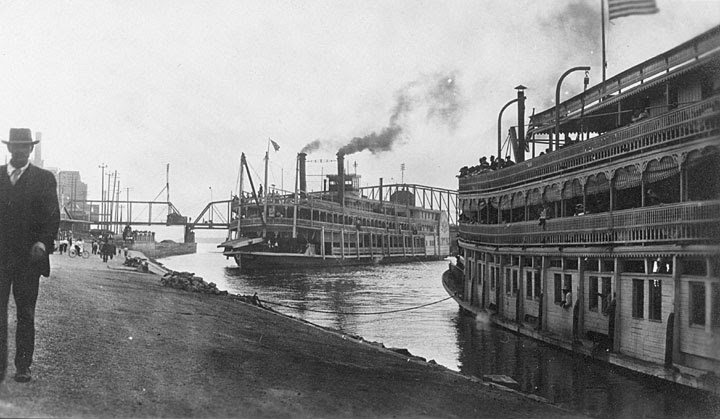
 
Early passenger travel was not a pleasant experience:  many of these immigrant families traveled in horrible conditions.  Among them were cramped spaces, often among cattle and pigs.  Passengers were exposed to diseases and enjoyed few luxuries.  Despite these conditions, steamboat travel opened immigration to settlers and their children.  The speed of travel made it possible for families to travel together, rather than have the father leave loved ones behind while exploring the wilderness with the hopes of returning for them much later.

As the years passed, steamboat travel for passengers became better.  Boat builders added more luxuries, making the experience something to write home about.   Again from the La Crosse Historical Society --

"The saloons of the boats were highly decorated with brilliant if not always artistic paintings.  Music was highly attractive to the passengers.  As brass bands were too expensive , a colored stringed orchestra was usually to be found in the main cabin.  These Negroes also worked as deck hands when unloading or loading the boat.  Six or eight Negroes who could play the banjo, violin and guitar, as well as sing, and who were also barbers, waiters, baggage hands were hired.  During their time off, they furnished music and received a little extra pay for it.  It was about 1879 that the first steam calliope was heard on the upper Mississippi."

"Three good meals were served on the boats each day, and the passengers were welcome to eat all they wished.  This was quite a contrast to the lower river boats, where passengers were expected to furnish their own food.''

"In the days of the keenest competition, all this and dancing was offered at the lowest prices, each company trying to outdo the other in an effort to gain trade.  They went so far as to keep agents at the railroad stations to persuade passengers to take their particular boats."


The glamorous style known as "Steamboat Gothic" attracted pleasure-seekers and wealthy travelers.

Herbert Quick wrote in "Mississippi Steamboatin' " -- "To mid-westerners in those days cabin passage on a steamboat was the ultimate in luxury.  More comfortable than their setting rooms and more ornate than their parlors, these travelers had never seen anything like it before.  The wooden filigrees that stretched down the long aisle in a tapering vista illuminated by glistening cut-glass chandeliers; the soft, oil paintings on every stateroom door; the thick carpets that transformed walking into a royal march; the steaming piles of food on the long linen cloth in the dining rooms, and attentive waiters standing with more food and desserts -- neither home nor hotels were ever like this!"

As interesting as it was to travel on a steamboat, they could be quite dangerous.  On the upper Mississippi River it was common for rival steamers to race, beam to beam, down narrow channels.  Their captains could ignore safety measures and occasionally ram their competitors to gain an advantage.  Boilers -- pushed beyond their limits -- occasionally blew up and killed passengers.

A well-known steamboat in this area -- the War Eagle -- burned at La Crosse in 1879 at the confluence of the Black and Mississippi Rivers with the loss of two lives and $215,000 in property damage.  A picture of the boat is painted on the side of a building near downtown.

I've often wondered about cost -- both to build one of these boats and to be a passenger.  According to early record keeping, the average steamboat -- accommodating 200 cabin passengers and 100 second class passengers would cost from $25,000 to $30,000.  Monthly expenses for the crew, food, wood and sundries were $11,500.  Passengers would pay $5 for a cabin when traveling downstream from St. Paul to La Crosse.  Traveling upstream was a little more expensive -- $6 from La Crosse to St. Paul.  The profit of the average boat for a season was about $56,300.

The average life of a steamboat was eight years.  Based on the costs of operating the boat and the large profit being made, it's easy to see why river traffic increased so much during the mid 1800's.

As quickly as they became popular, however, steamboats began to lose their appeal as railroads gained popularity.  In the year 1830, there were only 23 miles of tracks in the United States.  By 1880, there were 93,000 miles of tracks.  As the country moved into the 20th century, the invention of cars, trucks and airplanes signaled the end of steamboat traffic as a preferred means of transportation.

In the early 1900's, the Great Depression, the explosion of shipbuilding capability on the river because of WWI and II, and the rise of diesel tugboats finally finished the steamboat era.


*    *     *     *     *


As the great boat slowly pulls out from the landing, the quiet of the morning is disturbed by the mournful sound of the American Queen's steam whistle.  In my mind's eye, I image the captain in the pilothouse, grabbing the whistle handle and slowly pulling down against the pressure of the steam valve.  The captain's face is lit by the lights of the boat's control panel and the early morning glow of lamps in Riverside Park.

Another low moan can be heard from the gilded steam whistle atop the smokestack bonnet.  After blowing the long blast, the captain pauses to wait for the echo which comes shortly from the surrounding bluffs, barely visible in the early morning light.  It is almost like his last pull on the whistle has awakened the ghosts of previous steamboats that traveled this river almost 175 years ago.  The echoes continue until the last ghostly specter has vanished like a warm river mist.

And with a slight turn to the left, the American Queen continues its journey north through Winona, Wabasha, Lake Pepin and eventually St.Paul.

Life along the Mississippi River has inspired many people:  Mark Twain, with his wonderful stories of Tom Sawyer and Huckleberry Finn; and one of the greatest American musicals, Show Boat.  Both of these examples show the drama that lived in the daily lives of people along the river. “Ol’ Man River” and other songs are poignant reminders of how rivers wind their way through people’s lives as well as the American landscape.

"In my dreams I seem to hear a whistle shrill -
Like the whippoorwillin'  of the whippoorwill.
In my ears I hear it ringing
And the past to me it is bringing.

It reminds me of the dear old past
to me it is bringing.
It reminds me of the dear old Mississippi.

When I loaded cotton on that
stern wheel ship
They were the happiest days
there's no doubt.

On the Mississippi."

-- On The Mississippi, Ballard MacDonald, 1912


Wednesday, July 29, 2015

The New America

I have said many times before that one of the reasons I write this blog is to leave something behind for my children and their children to read.  By doing so, they will have a better understanding of who I am -- what was important to me, a little family history and a trail of cultural change that may some day seem too good to be true.


This is one of those days where I feel like my two boys will never understand how much life has changed in the years since they were born.  They will say, "Dad's doing drugs again!  This could never have been the way things were!"


Sadly, I'm telling the truth.

America used to be a country where dreams were made, where free speech, religion and traditions were not only accepted, but cherished.

Recently, schools, courts and our current mass media have been relentless in tearing down so many important things that someday there will be no record of them.  History books will conveniently alter why this country was founded; significant people and monuments will be removed and movies will be made rewriting who the good guys were and what they believed. My children's children will grow up believing that "this is just the way things are."  Ignorant to the fact that there was a time when this nation was great and people were proud to be known as Americans.

I've chronicled President Obama's attempts to slam American exceptionalism.  In his mind, American exceptionalism is something that needs to be apologized for because it makes other countries feel inferior.  The weaker we appear on foreign policy, human rights and economic strength, the happier he is.

Exceptionalism, as told in my household, is the foundation on which we have fought wars, for which we died and for which we are proud to display the flag.  It's not about bragging about our accomplishments -- its about believing we have a God-given right to be free people.  Free to do our best without the interference of government.

It's a contrast that in recent months has never been greater.  It's a sign that we are living in a new America.

Take the recent decision by the Supreme Court to rewrite law and allow Obama Care subsidies to continue.  Or to define marriage as something other than a union of one man and one woman.  Some may say the I'm just a sore loser -- which I am (I hate to lose).   But I firmly believe that activist judges are taking power away from Congress to write laws and removing state legislatures from having the authority to do what its voters want.

Its too easy for someone not happy with current affairs to challenge it in the court of law, where it is defeated then appealed again and again until it reaches the Supreme Court.  Once there, nine judges -- under the influence of cultural change and political pressure -- will make a decision that 99.9% of America hasn't voted on.  It's a concentration of power that our founding fathers could not have wanted.

Thank you President Obama, Harvard law professor.

Another  change can be found in recent treatment of blacks and illegal immigrants.  President Obama has made it clear he supports racial unrest by promoting false narratives about police brutality in St. Louis, New York City and Baltimore.  Instead of exhibiting a strong leadership role as America's first black president, he consistently picks at the scab of racial inequality to further his belief that white America has an unfair advantage.  WHITE PRIVILEGE! And this coming from a president who is supposed to represent all of us.

Racial issues are so out-of-control that the removal of the Confederate flag from South Carolina has morphed into something censoring old television shows and Academy award winning movies.  Historic Civil War monuments are spray painted and vandalized.  Public employees are removing confederate flags from cemeteries in Georgia.  Thomas Jefferson and Andrew Jackson are being removed from an awards dinner because they owned slaves.

We are truly living in a new America:   When something offends someone, it's beyond being politically correct. It justifies the need for change.  Activists maybe can't change history, but you can bet they don't have to honor it.

Free speech is classified as "hate" speech if it doesn't conform to the left's view of gay marriage or "black lives matter".  It's gotten so bad that someone, who is offended at a flea market by the sale of Civil War memorabilia, calls the police to complain.

Thank you President Obama, community activist.

His unconstitutional executive orders to allow illegal immigrants into this country have contributed to higher crime rates and a higher risk of a terrorist attack.  Rest assured when a black man (usually someone who has broken the law) is shot dead, you will be forced to watch weeks of non-stop coverage from the drive by media.  But let an illegal alien kill an innocent woman?  Good luck finding a story from ABC, CBS or NBC.

I read today that the Obama administration has stripped the requirement for naturalized citizens to defend this country.  In the past, candidates for citizenship normally declare that they will "bear arms on behalf of the United States" and "perform noncombatant service in the Armed Forces of the United States" when required by the law.  Today, that requirement is no longer necessary.

Why would Obama allow this?  Never before have laws been rewritten, ignored or blatantly broken without consequence or challenge.  How can people ignore such a blatant abuse of power?  Our freedoms are being threatened every single day and nothing is being done about it.

Another sign of the new America is how our military is under attack -- not from enemies in Iran, Afghanistan and Iraq, but from within our borders.  Home-grown Muslim terrorists are killing unarmed service men and it's being called a result of work place violence or the result of unmedicated depression.  Anything but the truth which involves calling terrorists radical Muslims.  And for no reason -- other than legacy building -- did President Obama and Secretary of State John Kerry negotiate a horrible agreement with Iran that bypasses Congressional approval and brings the world that much closer to World War III.

Thank you President Obama, negotiator-in-chief.

Our culture has become so rotten that I'm embarrassed to turn on the television.  It's not  because I'm easily offended or in denial of my age.  I ashamed to see all of these reality shows, to hear cable news programs ripping each other, and to find ESPN advocating gay athletes and transgender Olympians for their "courage.".

The attacks on religion have been successful in removing all consequences of bad behavior.  I am reminded daily that life has little value (Planned Parenthood selling fetal baby parts for money), rules are to be ignored until you get caught (have you watched people drive lately?), and language has deteriorated to the point that anything goes (if rap and popular music are any indication our youth put more value on respect than on earning it).

Our level of tolerance for people with different views has dropped to zero, as the left has chosen to prosecute anyone who disagrees with them.  Instead of disagreeing and moving on, businesses are sued and people are beaten in public.

And have the people we send to Washington D.C.ever been worse?  Until our elected officials listen to their constituents and are forced to take the same health benefits that are forced on us (think Obamacare) I refuse to contribute a single penny to anyone's campaign.  Sex scandals, money deals and political maneuvering that horrify us while watching "House of Cards" are simply telling the truth that none of us want to believe.

Yeah, the new America sucks.


I can hear my kids telling me to back away from the edge of the cliff.  "It's not as bad as you think, dad.  Change is tough when you get old."  Ok, I guess that makes me feel better.

I admit, the older I get the harder it is to change.  But why does change have to be bad?  Must I forsake so many of the things that I like?  For the most part, new technology makes my life better, but how does removal of the Ten Commandments or acceptance of a perverse lifestyle make my life better?

And how does spending more money -- no! wasting more money -- than what we have make my future better?  Someone said something so true about government spending that I wish I could find the quote and repeat it here.  It goes something like this --    "If you spend your money on yourself, you are very careful what you buy and how much it costs.  But, if you spend someone else's money on someone else, you don't care what you buy and you don't care how much it costs."  The last part explains why our country is $18 trillion in debt.

So, while standing here --  ankle deep in the sewage of failed government ideas and a politically correct culture -- I propose the following attitudinal change.  I know it won't make you feel better, but it allows us to go down fighting, and in my book that's much better than just taking it in the chops.

Let's get this election right.  We need a conservative candidate, not someone from the establishment right or left.  I know there are currently 16 GOP candidates wanting to be president, but if we want to take this country back, we need to look no further than Carly Fiorino, Scott Walker or Ted Cruz.  And while we are at it, let's show the RINO contingency out the door.  I am tired of faux legislation that allows Republicans to say "we tried, but couldn't get the votes."  Their election promises to stop Obama were good enough to help them to a landslide last November, but the proof is in the pudding:  taking no action on Obama Care, accepting his DOJ nominee and getting out of the way of the recent Iran deal aren't fooling anyone anymore.

Stop being afraid of saying what you think.  I'm not suggesting that you lie or slander those you dislike.  But it's long past the time for people to stand up to the politically correct crowd and stand for something.  The next time some Democrat shouts "Black Lives Matter!" ask them why they support Planned Parenthood where 90,000 black babies are aborted every year.  The next time you hear someone claim Conservatives don't care about the poor, ask them why -- after eight years of Obama -- minorities and the poor have never been in worse shape.  And why the middle class is shrinking.  The silent majority must find their voice.

Let the radical left eat itself into submission.  I know not everything will be as obvious as Hillary's destruction of her email account, but sooner or later, people are going to realize that the left is only interested in controlling our behavior and taking our money.  Let everyone know -- left right, black, white, female and male.  We're all in the same sinking boat, so it's time to bail out the water or sink -- and I'm not ready to sink.

There are signs that things could change in the near future.  Fox News has wrestled the stranglehold that the liberals in the media had for so long.  Today, all of the great liberal forums -- newspapers, television stations and news magazines -- have been slowing fading away.  Their days of incredible influence are past and in some cases they are struggling to survive.

That leaves it up to us to tell our children that life is more than going to college and organizing gay pride parades.  Today's reality -- a welfare state on the rise, the threat of ISIS, and the uncontrolled illegal immigration -- will force our children to deal with this new America sooner or later. It is our final responsibility as parents to prepare them for it.

Because America will never be the great country it once was.

Let's not be the last one's to know it.


Wednesday, June 24, 2015

Tales From The Crater

With each step, the worries of the day begin to drain away like water draining from the hanging baskets that add color to nearby houseboats. As Liz and I move down the dock area, a small painted turtle slips into the brown water, anxious for the cool down that must feel good after sunning itself on a floating cable.

Our pontoon boat, positioned straight ahead and to the left in slip D10, is ready.  The canopy is extended, providing a patch of shade against the hot summer sun.  A cooler with food and ice cold beverages promises a good time on the river as we prepare to drive down towards Brownsville, Minnesota.


Tonight, the winds are mild and the temperature in the mid 80's.  A perfect combination that makes boating so enjoyable.  We've had a good start to the summer -- with a couple of journeys to Lawrence Lake Marina for their Friday night steak fry and a weekend journey north through the locks to Trempealeau, WI for their Cajun Music Festival.  It was our first overnight stay and remains one of the highlights of the young boating season.

It's an experience that cuts both ways.

During the frigid months of January and February -- while standing in front of the picture window watching snow pile up in our front yard -- I have mixed feelings. I relish the memories of nights on the river to get me through our long, dark and cold winter.  But it's agony knowing that we have a ways to go before I can get the boat out of storage.  Such is the life of someone with a boat in Wisconsin.

I untie the ropes holding us to the dock and push the boat into an open area between docks D and C.  Liz, who is comfortably sitting in the captain's chair, slowly maneuvers us into the marina's waterway leading to a gas hut and new clubhouse.  She slows the boat to allow two mallard ducks, with a gaggle of young ducklings swimming behind them, to pass on their way to safer waters. We idle pass an odd collection of houseboats, runabouts and pontoon boats that remind me of an old Skipper Liner ad that ran on television during my high school days --   summer on the river and some are not.

With river levels down, I am able to see a line of white rocks that lead us toward the main channel.   Within minutes, we are leaving Pettibone Marina and heading toward our night's destination -- Crater Island Cove.  It's an area that holds many memories for me, including a couple of summers from 1978 and 1979.


*     *     *     *


When I was twenty years old, I was part of a small group of young men who traveled down the Mississippi River to take part in a sporting event that pushed our young bodies to their limits.

In Pool 8 of the Mississippi River was a large island of sand -- a remnant of dredging by the U.S. Army Corps of Engineers to keep the main channel of the river open for barge traffic.  Over the years, the amount of sand that was piled onto that island was enough to create a hill that was easily over 25 feet high.  In the middle of the island was a 100 yard long area that remained flat.  When combined, the island looked like your typical football stadium -- with the flat area resembling the football field and the piles of sand surrounding it resembling the stadium seats.

It was here, in an area surrounded by piles of sand, that the annual event known as the Crater Bowl was born.

The Bob Johnson family was your typical river rat family that spent every weekend and sometime weeks in between, on the Mississippi.  One of the areas that they would dock their houseboat at was a small sandbar that attached itself to Crater Island by a strip of sand bordering a small inlet that ran behind it.  It was common knowledge that if you wanted such a prime location for the weekend, you would need to grab it Thursday night or at the latest Friday morning.

Their son, Dave, who hung out with some of us during the summer, and his younger brother came up with the crazy idea of playing football in the middle of Crater Island.  It was an idea born out of the competitive spirit of young men needing a good excuse to run around and drink beer.

You might think that hot sand and sun would not make for good football.  But you'd be wrong.  Playing good football was never our intention.  Winning at football while playing in the sand and sun was our intention.

Our formula for winning was to stay sober long enough to last into the third and fourth quarters.  If the score was close, then we felt like we had a chance.  If you've ever walked on a sandy beach or played sand volleyball you know how hard it is to get any kind of traction, so cutting left and right required an equal amount of skill and strength. Our goal was to take advantage of their bad footing and miscues -- an interception or blown coverage  -- and turn it into a big gain or score.

Game-time temperature in the bottom of the sand bowl easily reached into the nineties if not closer to a hundred degrees.  All of which led to more beer, and then more football.

Our games featured two teams -- the young guys (a group of high school kids led by Dave Johnson's younger brother against an "older" team, with Dave Johnson as our captain.  That older team included myself,  Tom Carr (Bun), Doug Schoenfeld (Clud), Paul Mundinger (Stein), Tim Wuebben (Wib) and Glenn Gossfeld (Goose), to name a few.  None of us were great athletes, but we were still in our twenties with lots of time playing touch football in the grassy field next to Bun's house.  What more did we need?  We were banking on our experience to bring home the trophy, which was nothing more than the knowledge that we were better than them for another year.

To show our level of seriousness, we video taped the game and kept statistics (thanks to Goose, who would later keep the books for the La Crosse Catbirds and Milwaukee Bucks).  Fans -- other boaters who happened to climb the outer edge of the bowl -- would watch with the friends of the Johnsons who were not playing.  They must have thought we were crazy.

A newsletter was printed, which covered all parts of the game and sent to participants.  After the game, we would eat and re-watch the game and other movies until we dropped from exhaustion.  Or a day of drinking.  I can remember falling asleep in someone's boat, which wasn't a bad idea until it started to rain.

For me, the Crater Bowl never got past the second summer.  If it continued, I don't know.  But as I began spending summers with a certain brown-eye girl who I met at Dell's Bar, and later chased to Michigan, my summers on the river dwindled to none.  The river was replaced by Lake Michigan, although it was usually from the shore.  An occasional night spent on a friend's houseboat kept the flame flickering, but for the next fifteen years most of my time on the Mississippi River and Crater Island was spent in my head.

Remembering the fun we had thinking we were better at football than any of us ever admitted.


*     *     *     *


I turn the ignition key and slowly back the pontoon boat away from the sandy shore.  Ahead, the sun's reflection is scattered into tiny pieces of light as we maneuver through the opening and head into the main channel.  Behind us, the motor's wake sends ripples through the water's smooth surface.  It is time to head north -- back to the land of hot concrete and humanity.  There is an evening chill in the air that prompts Liz to grab her sweater and put it over her shoulders.

Leaving the quiet confines of Crater Lake, I reflect on its transformation from the pile of sand we enjoyed in my twenties to the shrinking cove it is today.  From 2006 to 2010, the U.S. Fish and Wildlife Service and U.S. Army Corps of Engineers closed Crater Island and began barging sand from the island to create new islands further downriver.  Twenty-six islands were created or protected as part of the Corps Pool 8 habitat restoration and enhancement project built along the Raft Channel in Wisconsin.

When they were done, they had transformed Crater Island from a massive pile of sand into an island with a small cove that filled with water from the Mississippi River.

In many ways it is better than before -- a larger area for beaching boats and for swimming.  On a windy day, you are protected and can safely beach the boat, instead of anchoring it so it you don't float downstream.  On week nights, it's quiet enough that you can enjoy the beauty and sounds of the Mississippi River.  And eat a light dinner of pizza or chicken or sub sandwiches.

But on weekends it's the party capitol of the Mississippi River.  Between fifty to one hundred boats crowd the beaches on your typical Saturday or Sunday.  A quick look on Facebook will show pictures of bikinis, boats and booze.  Lots of booze.  As one poster said, "It's the place to party your ass off!"

As I've gotten older, I'm thankful I survived my wild, younger days.  Had I known how stupid we looked, I never would have done it.  But if you're looking for a party, with the smell of suntan lotion and diesel gasoline in the air, I know a place you can go.

Like football in the sand, it's just not for me anymore.

Every season brings a different look to Crater Island -- from the lengthening shadows of a late summer night, to the colors of fall as they spread across the bluffs rising above the small town of Brownsville, Minnesota.  If you're lucky (and have enough notice), you can climb the southern end of Crater Island and wait for the majestic paddle wheelers coming down the river from La Crosse.  Or sit back in a partially submerged beach chair and bask in the warmth of a hot summer sun.  There have been evenings when we will grab a life preserver and float around the cove area.  Climbing back into the boat, we literally feel the aches and pains of the day sliding from our bodies as the water drains from our drying bodies.

In the skies above Crater Island we have watched American white pelicans circle by the hundreds as they migrate south to avoid the inevitable chill of late fall and winter. They will appear in a flash as the sun reflects off their white plumage, only to vanish seconds later as they change direction.   Much like our visit to the cove tonight, it is but a stop for these pelicans along the way to another destination.
 
Liz and I don't know what our destination will be in ten or twenty years.  We struggle with talk of retirement and old age.  Some of our boating friends plan to leave Wisconsin for the warmer climates of Florida and Arizona.  Perhaps Liz and I will follow suit, or find our way back to the Great Lakes and Michigan.

Regardless of where our future takes us, I will always remember the friendly confines of Crater Island where young men played football, and boat lovers found temporary relief from a hot summer day.


Wednesday, June 17, 2015

It's The Thought Police!

Pat -- my conservative lifesaver in a sea of liberalism at the office -- stopped at my door recently and asked, "Does it offend you if I say "shut up"?"

"Depends on if we're talking about Bret Favre or not," I joked.  Then I see his face and realized he's being serious.  "Not really, why?" I asked.

"Because my kids are telling me that it's not nice to say that to someone."  He stepped into my office, in the hopes that our conversation wouldn't travel past my door.  "Their school is telling them that they can't say it anymore because it may hurt someone's feelings."

I pushed my chair back and thought, what the hell?  Just another sign our schools are screwed up.  "That's nuts, " I said.  "I could see not be able to talk to your teacher that way, but to other students?"

"Yeah -- you can't say anything today without offending somebody.  It's nuts!"


In light of Pat's comments, I'm reminded of one of my favorite bands from high school, Cheap Trick.  They had a hit song called "The Dream Police."  It was a catchy tune with the following lyrics:

"I try to sleep
They're wide awake
They won't let me alone
They don't get paid to take vacations.
Or let me alone
They spy on me
I try to hide
They won't let me alone.
They persecute me
They're the judge and jury all in one."


What seemed paranoid more than thirty-five years ago now seems pretty common as political correctness has taken over the mindset of our children in school who have been indoctrinated with nonsense about sensitivity, equality and self esteem since entering kindergarten.

How bad is it?  Worse than I thought.  I try to avoid as many of these stories as possible because they depress me and make me want to sit in my boat and float down the Mississippi River.  Unfortunately, I can't ignore some of the stories that pass my way, and so in the interest of reminding my two sons that they are truly screwed I give you the following:


1.  A physiology professor at the University College in London was recently forced to resign from his position for remarks he made at a conference on women in science in South Korea.  Tim Hunt, a biochemist who won the Nobel Prize in physiology in 2001, was accused of being sexist over a joke he told during the opening of his speech at the conference.

Here's the joke:

"Let me tell you about my trouble with girls.  Three things happen when they are in the lab.  You fall in love with them, they fall in love with you, and when you criticize them, they cry."

That's it.  There's nothing more to the joke.  Mr Hunt wasn't high on drugs or drunk when he gave the speech.  He didn't use profanity or use the N word.  All he did was tell the truth.

Some women do fall in love with their lab partners.
Some men fall in love with their lab partners.
And in my experience I have seen girls cry when criticized.

The fact that this joke caused such a major uproar indicates that feminists are still without a sense of humor and our colleges are run by a bunch of administrative pansies who will throw a Noble prize- winning biochemist overboard in favor of some politically correct instructor who will faithfully toe the liberal line.

Comments -- coming from those who were offended -- indicate how colleges today have become untethered from reality:

The University published a letter on its website that said, "UCL was the first university in England to admit women students on equal terms to men and does not agree with the comments Hunt has made."  Connie St. Louis, director of the science journalism program at City University in London, heard the comments at the convention and tweeted, "Really, does this Nobel laureate think we are still in Victorian times?"

I don't know what times we are in, but I know no one should ever tell a joke at UCL.


2. Angelique Clark, a sophomore student at West Career and Technical Academy in Las Vegas, said the Clark County School District denied her application to charter a pro-life club as a chapter of Students for Life in America, the nation's largest youth pro-life organization.

The school district explained itself like this -- "It was too controversial, and it would be too exclusive and it would leave out pro-choice people."

Huh?  My first thought was this is too controversial?  How about a teacher in a human sexuality class asking students to witness a live sex act between a woman, her boyfriend and another woman?  Or what about a class called "Queer Musicology," based on the idea that if you're gay then music by gay composers will sound different than it would if you were straight?  Or a class favorite called "Phallus 101" -- which uses a survey of critical theory and social justice of "feminist and queer takings-on of the phallus?"

And isn't the purpose of a club to attract student of like mind and skills?  Using this rational, a Spanish Club excludes students interested in German, French and Russian.  How dare the Chinese Club plan a trip to the Great Wall of China, when there are people who want to visit the Louvre in Paris?

It makes no sense, unless you are a liberal school administration determined to censor opposing views.  My guess is they are the same leftists who ridiculed students who opposed gay marriage. -- calling their opposition "hate speech."  Or who led the opposition against conservative speakers like Ann Coulter and Star Parker, a young African-American speaker on the harmful impact of abortion on black families.

Their hypocrisy, intolerance and tyranny are common throughout high schools and colleges who fashion themselves as institutions of independent thought and free speech.


3.  Jerry Seinfeld, who had one of television's biggest hits in the 90's, has been making the talk show circuit lately complaining about college students being too "culturally sensitive."  Too politically correct, and as a result they can't take a joke anymore.

While talking to ESPN's Colin Cowherd, he said:   "I don't play colleges, but I hear a lot of people tell me, "Don't go near colleges.  they're so PC'."   He said teens and college-aged kids don't understand what it means to use certain politically-correct terms.  "They want to use these words -- racist, sexist and prejudice."  Seinfeld said, "They don't know what the hell they are talking about."

As proof, Seinfeld shared on of his favorite jokes -- a commentary on the nature of cellphones which relies heavily on the way gay men move their hands when they speak (in a "flourishing motion").   The punchline -- which involves a comparison to a "Gay French king" -- has fallen flat with politically correct crowds, who think, ‘What do you mean gay? Why are you talking about being gay? What are you doing? What do you mean?’

I thought, ‘Are you kidding me?’”  Seinfeld continued: “I could imagine a time where people would say that’s offensive to suggest that a gay person moves their hands in a flourishing notion, and you need to apologize. There’s a creepy, PC thing out there that really bothers me.”

So, you want to hear a really funny joke?  Chris Rock recently said that he's stopped playing colleges not because they're too politically correct, but because "they're too conservative."  Now that's a good one!


To tell you the truth, I don't feel much sympathy for these coddled students who can barely read and write.  After all, they are the offspring of parents who rioted in American streets and planned its overthrow during the 1960's.

Nor do I have sympathy for the high schools and colleges who must be wondering if the monster they created (like the monster in Mary Shelly's Frankenstein) is beyond their control.  When the monster refers to himself as "the Adam of your labours," he is reflecting back onto Dr. Frankenstein and trying to justify his feelings of vengeance and remorse.  Just like today's students who are trying to justify their feelings of political confusion and misery -- courtesy of an education system so offended by the founding principles of this once great country.

Let's hope this story ends better than the one where the Frankenstein monster drifts away on an ice raft that is soon lost in darkness, never to be seen again.


Friday, April 3, 2015

Five-oh-nine, 38 degree Hefe and Sammie the Big Shot


Ward casually speaks into his phone and asks "Give me the Wisconsin-Arizona score."

A moment later, Ward asks again,"What is the score of the Wisconsin-Arizona game?"  When nothing happens, he looks at me and says, "I don't think I'm getting a good connection.  Let me try something else."

I tilt my head up toward the wooden beams running along the ceiling and take a deep breath.  Maybe I should just get out of my chair, walk downstairs and see what the score is on the television playing in the bar area.  Standing up might feel better anyway.

"Here we go," says Ward, teasing me with a smile on his lips.  "It says.... Oh, now I lost it again."

God Almighty, I think as our waitress arrives with our green fried tomatoes, covered in a cheesy sauce and bread crumbs.  Suddenly, I have no appetite and fear that I won't unless I get good news quickly.  I close my eyes and take another breath.  Somewhere the thump, thump, thump of the music heard during someone's elimination on "Dancing with The Stars"  is playing.  Finally, from my right I hear Ward say "85-78.  Wisconsin."

"Honestly?"  I ask, as a jolt of excitement hits my body.

Ward nods and slides his finger across his phone.  "That's what it says:  Wisconsin going back to the Final Four.  Defeats Arizona 85-78."

And just like that, my weekend has suddenly gone from good to great.


We are in Galena, Illinois for a quick weekend with Betsy and Ward Jones, enjoying some fine wine and hearty beers.  It just so happens that it's during March Madness, with Wisconsin fighting for a chance to return to the Final Four in college basketball.

When Liz and I talked about making this trip, I knew there was a good chance that the Wisconsin Badgers men's team could still be playing.  As a number 1 seed, they had what it took to go far in the tournament with a possible match-up with second-seeded Arizona in the Western regional finale.  Such are the risks of going somewhere at the end of March.  Last year we were in Chicago visiting Liz's family.  This year -- it is historic Galena with friends from La Crosse.

Adding to the excitement was the annual Wine Lovers Weekend going on in Galena, one of the largest wine tasting events in the state of Illinois.  The Grand Tasting featured more than 40 distributors from across the United States with over 300 varieties of wine and spirits.  Having never been to it before, we really didn't know what to expect.  But it sounded like a good excuse to indulge our passion for tasting wine wherever we can.

By the time our shuttle dropped us off, the hall was packed with vendors, representatives from wineries throughout the country and tables full of cheese, crackers and fruit. The festival's Grand Tasting was scheduled between 4:00 and 6:00 on Saturday which meant I would be sampling someone's Riesling or Gerwertenimer about the time the Badgers and Wildcats would tip off at 5:09 p.m.

It's typical for me to wear my Wisconsin shirt on days when the Badgers are playing, so all day Saturday people in town (and the Grand tasting) would look at my shirt and say 5:09 meaning the Badgers' game.  It became kind of a secret code (or verbal high-five) for us Badger fans, signaling that we were excited about kick-off.  I was surprised to see how many Wisconsin fans there were visiting Galena, but now that I think about it, everyone is a fan of March Madness.  So why not the Badgers?

When Liz and I walked into the wine tasting hall, the man who greeted us assured me that us would announce the Badger score if we needed a quick hoops fix to get through the afternoon.  I never did ask, as it seemed out of place at a wine tasting event (like eating with your fingers at a Five Star restaurant).   But I did see a few Wisconsin fans walking among the crowd with a confident look on their faces as we bravely acknowledged each other with our 5:09 declarations.


Another Wisconsin win!  I've been saying for two weeks that all I want is one more victory...

As a Badger fan, it is indescribable how I am feeling.  Try as I may, I will never be able to act like we belong here.  For most of my life, college basketball has belonged to teams like Duke, North Carolina, Kentucky and Michigan State.  It defies all logical thought that we should be as good as them, and yet here are in the Final Four.   Again.

Maybe that's why I didn't mind missing the end of the game.  I still expect them to lose a lead in the final seconds, or embarrass themselves to blue bloods like Duke and North Carolina.  But not today.  I smile and shake my head in disbelief.  This is the most awesome feeling in the world.

Time to celebrate!  We are already celebrating at Green Fried Tomatoes, a great restaurant in Galena.  Years ago, Liz and I had enjoyed a meal at GFT when it was located outside the city limits.  We are surprised to see that they have relocated to downtown.  Osso Buco, steaks and lobster are listed on the menu, as is the obligatory green fried tomatoes.

I suggest a round of Jagermeister for the four of us, but nobody seems interested.  Or more accurately -- no one has room for a round of shots.  We are stuffed.

We have spent the afternoon and early evening at the wine tasting festival, and part of the day in Lena, IL where we drank beer at Lena Brewery.  Our friends are investors in a recently-opened micro brewery and it was our first chance to sample their collection of homemade brews, including one called Hefeweizen, or 38 degrees Hefe.


Lena Brewery opened in late January, with all the excitement of Dr. Frankenstein creating his monster and bringing it to life.

The owner, who used to brew his own beer at home, was finally able to make his passion his work.  Lena Brewery is located in an old mill building and is part of a complex featuring a furniture store, gift shop and restaurant.

The micro-brewery has a saying that "every beer has a story.  Some are even true."  We were eager to sample some of them, much to the delight of our friends the Jordans who lived nearby.  Our sample flight of beers included Scrap Iron Black IPA, Ravenscourt Park Chocolate Brown, Uncle Tyson's Dunkelweizen, Pog Mo Thoin Amber, Thrashed Oats, Bloodshed Extra Special Bitter and my favorite, 38 degree Hefe.

Ward, who thinks the world is a better place with IPAs, couldn't be happier with the dark, bitter flavor of the Scrap Iron and Bloodshed.  I on the other hand, need my beer to taste like something that wasn't scrapped off a burnt coffee pot.  The lighter taste of the 38 degree Hefeweizen (Hefe) reminded me of Spotted Cow, a favorite from New Glarus Brewery.  According to the story told by Lena Brewery, if the temperature of this golden-colored hefeweizen gets much above 38 degrees, it can spontaneously combust.  Fortunately for me, I didn't give it a chance.

The incredible rise in craft breweries continues to amaze me.  While not on the scale of a major brewery like Miller or Budweiser, we enjoyed our visit to the taproom and  brew house.  Unlike the wine tasting festival, we were able to take our time and talk to the men and women responsible for crafting these brews.  And to top it off (no pun intended) the men's and women's bathrooms--with their industrial look and ingenious use of beer barrels and tappers -- made going to the toilet an experience you won't forget.

Speaking of forgetting, someone in the taproom asked me if I knew when the Badgers were playing.  With pride, I said "5:09."


As we are leaving the restaurant, I spot a group of six people sitting at a long wooden table.  Two are wearing Badger tee shirts, and having a great time.  As I walk past, I proudly state "On Wisconsin!  How 'bout those Badgers?"

A couple of high fives later and we are on our way down the stairs to the main floor of the restaurant.  The excitement I feel is like some out-of-body experience that comes from thinking you're walking in someone else's shoes.  For me, it's like watching the NFC Championship game with a different ending.  In this version, Jordy Nelson recovers the on-side kick and the Packers run out the clock.  Super Bowl bound, baby!


I've asked some people what they think is harder to achieve the Final Four or the Super Bowl.  Given the number of games you have to play and the sequence of events that must occur for you to get there, I'd have to say the Final Four.  Of course I'm speaking as one of those teams that doesn't load up on one-and-done type players -- like Kentucky and Duke.  It is much harder to overcome the regional seatings and dominant players who create so many mismatches.  It's five on five -- the team with the best five with the deepest bench usually win.  There's no parity like there is in football.

So it is with disbelief that I am watching Wisconsin do it back-to-back.  Who are these players that are capable of beating the likes of Michigan State, Oregon, North Carolina and Arizona?  And how did they get to Wisconsin?


A big part of Wisconsin's winning season is Sam Decker.

The story going around local newspapers has Bo Ryan asking Sam Decker to come to Wisconsin to get to the Final Four and win a national championship.   How ridiculous, considering the UW program had endured a 46-year NCAA Tournament drought before Dick Bennett, a few years before.  After winning the title in 1941 - when the field was only eight teams - UW did not return to the tournament until 1994.  Eleven senior classes came and went without experiencing March Madness.

With Bo at the helm, UW has returned to the tournament every year.  And with the addition of Sam Dekker, the team has two Final Fours and more NCAA Tournament victories than any other Big Ten team.

So who is Sam Decker?  And has there been a better performance than the one he put on in Wisconsin's win over Arizona?  His big shots led UW to a blistering 78.9 percent from the field (15-19) and 83.3 percent from the 3-point line (10-12) in the second half.  For the tournament, WI leads  the field is scoring thanks to Frank Kaminski and Sam Decker.

Decker was the Wisconsin Gatorade Player of the year and a 2012 Parade All American.  He amassed 2,629 career points, finishing as the fourth leading scoring in Wisconsin high school history.  While not as prolific in college, he has started every game for the Badger and is second on the team in scoring.  His ability to put the ball on the floor and slash to the basket has made him difficult to stop.  At 6-9 and 230 pounds, he has the length and strength to dunk the ball or shoot a three pointer almost at will.

Today's announcement that Frank (the tank) Kaminski is the National Player of the Year, is awesome news.  But to me, who is still watching repeats of the Elite Eight game -- it hasn't made me forget the final dagger from the Arizona game.  A high-arcing three pointer that Sam Decker put up with 19 seconds to go, just beat the buzzer and propelled WI to Indianapolis where they face Kentucky for the second year in a row.  It is a big shot that will go down in Wisconsin history, and one that will be replayed in my mind for a very long time.

Together, Kaminski and Decker make one of the better combos in men's NCAA basketball.  But will it be enough to get them to the national championship game that his coach mentioned three years ago?

If Sammie the Big Shot has anything to say about it, I like our odds.

Wednesday, March 25, 2015

Conscious Capitalism

Liberals are like the Spartans from the movie 300.  They never give up.

On the heels of faking a story about campus rape because they think it's true somewhere, comes the latest attempt to shape reality and think "racial inequality" can be solved over a cup of coffee.

I'm talking about Starbucks decision to engage customers in a conversation about race by scribbling liberal activism on a cup.  This new marketing campaign is the brainchild of CEO Howard Schultz, who is urging Starbucks' employees to "perform a small gesture of writing 'Race Together' on a cup.  And if a customer asks you what this is, try and engage in a discussion, that we have problems in this country with regard to race and racial inequality, and we believe we're better than this, and we believe the country's better than this.  And if this makes you have a conversation with a customer about the need for compassion, the need for empathy, the need for love towards others, if you can do that with one customer (each) day, then you're making a significant difference as we go forward."

Schultz concluded, "I think this is really important not so much for the company, but for the country."

According to Schultz, "RACE TOGETHER is not a solution, but it is an opportunity to begin to re-examine how we can create a more empathetic and inclusive society — one conversation at a time.  Rules of engagement, in regards to this issue, must change."

I couldn't agree more.

Race relations have taken a big step back since Obama became president.  You have the "beer summit" following the arrest of Harvard professor Henry Louis Gates, the Trayvon Martin shooting trial in Florida, and the Michael Brown shooting resulting in the Ferguson riots.  It is my opinion that most blacks feel Gates, Martin and Brown were  innocent in each instance, and the offending officers should have been held accountable.  Conversely, whites agree with the verdicts handed down, and feel the riots that followed are an excuse to cause more trouble.

And thanks to President Obama -- inflaming tensions and fostering divisions among whites and blacks -- this country is in worse shape now than in the past 50 years.   I understand that's what a community organizer does.  It's not to make things better -- it's to keep things stirred up.   So slogans like "Hands Up!  Don't shoot!" and the conscious efforts made by NFL and NBA teams to side with other blacks is not a surprise.

And yet here is the CEO of a well-known business, thinking words can make a difference.  This self described conscious capitalism has nothing to do with solving the problem.  And it is nothing more than what the left has been doing for decades.  Describing good intentions and hoping they trump common sense. 

But here is the reality:  talking about a problem doesn't solve the problem.

It's the same concept used to describe Secretary of State, John Kerry, sitting down with known-terrorist supporter, Iran, to talk about nuclear negotiations and reduce sanctions while tens of thousands of protestors shout DEATH TO AMERICA outside the U.S. embassy.  If I was a political cartoonist, I'd draw a picture of Kerry signing the nuclear agreement, then handing over the pen to Iranian President Hassan Rouhani -- who promptly stabs him in the back.


There are other reasons why this "RACE TOGETHER" idea is bad:

. Some people are not morning people.  I wouldn't discuss anything political until after two cups of coffee.

. If you're rushed getting to work, do you want to wait in line while the person ahead of you carries on a conversation on race?

. What makes Starbucks think the people preparing your coffee know anything about race?

I'm betting most of them spend more time searching through Yahoo Entertainment (what is Kim Kardashian up to?) than reading Thomas Sowell's view on racial disparities.  I also don't think they get a very balanced discussion of race problems by absorbing what's being taught in our state's universities.  Three quick examples:

A Seattle university physics teacher has asked his class to study why there are so few black physicists.  Is it because blacks are not smart enough, not being exposed to science, or not getting opportunities?  Having made the assumption that whites have an advantage over blacks, the assignment continues by asking students to write about how they feel about this "white privilege"? The professor readily admits to feeling jealous about his colleagues in English and History who get to talk about society and morality every day.

Another example is having to write a history paper on early exploration and discovery in America.  Students are asked to take the side of native Indians in debates -- focusing on the death and destruction that Columbus and the pilgrims brought to the Indians when they arrived in America (my sons were given that assignment in 9th grade).  

A third example  involves a recent episode of "The Walking Dead," where students led a discussion about why only black characters on the show were being killed off.  Surely there was someone at the network making a conscious effort to discriminate against black characters in favor of keeping white ones alive.

So with this educational background -- white privilege gives some of us an unfair advantage -- what chance is there that I could have a balanced discussion about race? 

. If the left wants a conversation about race, shouldn't they be following their own advice?

Starbucks' initiative also includes partnering with USA Today. Larry Kramer, USA Today's editor and publisher said of their partnership, "Our nation is only becoming more diverse. To ignore, dismiss or fail to productively engage our differences is to stifle our collective potential. Diversity of thought and skills lead to more creative ideas and higher performance. Bias, even unintentional slights, sap our potential for shared prosperity while denying our shared humanity."

Like most talk coming from the left, that sounds pretty good.  How can you argue against diversity, collective potential and shared prosperity?  But if you do a little research to see if USA Today or Starbucks practice what they preach, you'll find something surprising.

According to a review of Starbuck's executive management team, which consists of 19 people, 95% are white.  USA Today has one woman and 7 men on its editorial board.  All white.  Other media that eagerly support race discussions are no different.  Time Warner (CNN's parent company) has an executive management team that is 100% white.  The New York Times' management team has one black on a staff of 14.  The Washington Post's leadership team has one woman, one Native American and 11 white men.  Not one black.


If "racing together" is so important to CEO Howard Schultz, why doesn't Starbucks have any coffee shops in Ferguson, MO?  Why is he so quick to put demands on us, when he refuses to do the same himself?   The answer is typical of so many liberal companies that have skin in this race game.  Words trump reality.  It looks good and makes them feel better than others.

How else would you explain the USA Today saying, "elevating diversity is not only the right thing to do, but ... also a necessity." Apparently the necessity is in creative ideas and diversity of thought, not black butts sitting in their board rooms.  Preaching tolerance, diversity and racial acceptance sounds good, but it seems like it has a hard time making to the top floor of all of these important organizations.


In the time it has taken to research and write this blog (about a week), the "Race Together" initiative has run its course.  Beginning today, Starbucks has put their much publicized initiative on hiatus.  Claiming "Race Together" was always meant to be a week long discussion (although I can't find any reference to it), Schultz and Kramer feel like it has been a success.

And Starbucks is still planning to foster conversations about race -- just not by having their baristas on the forefront of that conversation.  Therefore the following comments have been released:

"The phase-out is not a reaction to any pushback.  Nothing is changing."  

"It's all part of the cadence of the timeline we originally planned."

"We're leaning into it hard."

"While there has been criticism of the initiative -- and I know this hasn't been easy for any of you -- let me assure you that we didn't expect universal praise."

"This campaign... will make sure that the promise of the American Dream should be available to every person in this country, not just a select few."

I know that we have a problem in this country when it comes to politics, race and jobs.  And I don't mean to be critical of anyone attempting to find solutions to those problems.  But I will be critical of  businesses like Starbucks and USA Today that think they have the answers when they are the ones perpetuating the problem.  By throwing words on paper, money at poverty, forcing equality where none exists and blaming white priviledge they have made finding an equitable solution much harder than it needs to be.

Blacks and whites need to find common ground that can withstand the attacks of community organizers, and the prejudices of those who give credence to actual discrimination and violence.

Writing "Race Together" on a coffee cup does neither.

Saturday, March 7, 2015

Adam and Eve on a Raft

I turn up the collar of my coat, hoping to knock down the icy blast of wind that creeps down my back before meeting the chill working its way up my pants legs.

Liz, Sean, Matt and I are standing in line outside Al's Breakfast, a 10-foot wide diner sandwiched into an alleyway between two buildings in the Dinkytown neighborhood of Minneapolis, MN.  The cold weather really has me questioning my sons' belief in global warming, and the wisdom of waiting more than 20 minutes for pancakes and eggs.  But ever since Matt attended the University of Minnesota, he has raved about Al's Breakfast.   So it's just bad luck that we picked one of the coldest days of the new year to check it out.

The Dinkytown neighborhood is located just north of the University of Minnesota East Campus and populated by locals and university students.  Through the years, it has been a central area for the 1950s beat culture, the 1960s counterculture and the 1970s anti-Vietnam movement.  In Dinkytown, notable landmarks include the Dinky Dome, the Loring Pasta Bar (rumored to have been where Bob Dylan lived for a short time), the Varsity Theatre and Al's Breakfast, possibly the smallest restaurant in Minneapolis.  Twentieth-century, low-rise buildings surround us on this cold morning, with hardly a frozen breath in sight. 


"I thought if we got here 20 minutes early we'd be good," says Matt, as puffs of white escape his mouth, only to be swished away with another gust of arctic air.  "But by my estimate, we still aren't going to be able to get a seat right away."

Matt explains that Al's Breakfast only seats fourteen, so I begin counting the huddled bodies waiting to get in out of the cold.  Sure enough -- we are numbers fifteen through eighteen, so I guess Matt is right.


What is it about diners that make them such a draw?  Even on a cold January morning?

Since their arrival in the late 1800s, diners have been part of the American experience.  Their influence has touched so many parts of our lives, including cooking, eating out, popular culture, design and television/movies, that it's hard to overlook.

The origins of the diner can be traced to Walter Scott, who supplemented his income by selling sandwiches and coffee.  Fourteen years later, with business becoming so lucrative, Scott quit his job as a part-time pressman and started selling food at night from a covered express wagon outside his old employer, The Providence Journal.   In doing so, Walter Scott gave birth to what would become one of America's most recognized icons --the diner.

Through the years, diners have "evolved" from Scott's simple lunch wagon to something much more elaborate (although certainly not elegant).  In the early 1900s, lunch cars became larger and more self-contained, with lengthy counters, mid-side entrances, tile work, porcelain panels and even bathrooms.  Although they continued to cater to night workers, many lunch cars assumed permanent locations which allowed around-the-clock customers and greater respectability.  Companies, seeing potential in these new permanent structures, brought new styling which included that of the railroad's Pullman dining cars, giving birth to the name diner.

During this period of growth, the main streets of America were also changing.  With the popularity of Henry Ford's automobile, new eateries popped up as road construction boomed.  Food stands like A&W and White Castle -- catering to the automobile -- could be found spouting up everywhere.

During the Great Depression, tough times meant small diners started to replace the larger complex diners which were too expensive to maintain.  These 8 to 10 person diners -- simple and boxy -- were often carted to certain locations just like Walter Scott's original lunch wagons.  The food was nothing special, but people came for good food and fun.

In the years following, diners continued to evolve.  Much of their charm was enchanted by art-deco designs featuring modern, futuristic lines and colors.  Many used neon (which was new at the time) to draw attention and create interest.  During the next 50 years, diners reached new heights before falling out of favor to homogenized food chains like McDonalds and Burger King.

Nonetheless, diners continued to have a nostalgic appeal popping up in movies like American Graffiti and Diner.  Television brought us Flo and Happy Days, which lasted for many years.  A famous painting by Edward Hopper called "Nighthawks" is based on a diner in Philadelphia, and shows a lonely encounter between a man and waitress late in the night.

Fortunately a few real-life diners survived -- and through the efforts of some to restore and preserve them, are still with us today.

There is something inherently different -- but fun -- about going into a diner.  Almost like its free entertainment.  If it's not the employees or food, maybe it's the nostalgia.  There's a sense of going back in time when you walk into one -- the round stools, the cooking appliances so black with use that it's a wonder they still work, and all of the memorabilia unique to the owner's guests and visitors. 

Don't expect any wi-fi hotspots, or polite conversation.  For the most part, regulars are acknowledged, but not patronized.  Menus are simple and don't change much.  Noises from the kitchen sometimes sound like a war zone -- complete with shouting and utensils flying through the air.  For its entertainment value, expect to spend as much time watching the staff as eating the food.

Diners are not only unique in the food they serve and the environment under which they operate.  Many also employ a unique vocabulary -- diner talk is as much fun to hear as it is a mystery to understand.  Who knows where some of this vocabulary comes from, but it is incredibly creative and transcends race, gender and age.

Adam and Eve on a raft:  two poached eggs on toast
Angels on Horseback:  oysters rolled in bacon and served on toast
Beagle Fingers:  sausage links
Blowout patches:  pancakes
Burn the British:  toasted English muffin
Cowboy with spurs:  western omelet with French fries
Drag it through the garden:  sandwich with all condiments on it
Dry stack:  pancakes without butter
Gentleman will take a chance:  a plate of hash

Heart attack on a rack:  biscuits and gravy
Hold the grass:  sandwich without lettuce
Let it walk:  an order to go
Mousetrap:  cheese sandwich
Nervous pudding:   American jelly
Paint it red:  put ketchup on a dish
Radio sandwich:  tuna fish
Soup jockey:  waitress
Spit in the eye:  egg fried in the center of a holed out piece of bread
Walk a cow through the garden: hamburger with lettuce, tomato and onion

I wonder if any of the employees find it hard to turn off this language when they leave work?  Or does the waitress, during a night on the town, walk into the bar and say,  "Hey baserunner.  Give me some balloon juice with a ball of fire.  And do you have any belly furniture to go with that?"


The bearded man behind the counter instructs us to wait a moment while two men get out of their seats and shuffle to the left, allowing us to sit next to Sean and Matt who were already sitting at the counter with menus in hand.

"Finally," I say.  "I'm starving, and standing behind people eating only makes it worse."  Because Al's Breakfast diner is so narrow, customers who are not eating must wait while standing patiently behind those eating at the counter.

In the kitchen (out of sight), a short-order cook yells, "Order up, John!  Jose with wheat on #2."   Shortly, a plate with two poached eggs with cheese, hash browns and salsa is placed before a customer sitting nearby.

Having waited 20 minutes for a seat, I've been able to take in the eclectic atmosphere of Al's which includes cheap, hanging Tiffany lamps embraced by strings of white Christmas lights above the counter where we are sitting.  On the wall before us is a greasy collection of foreign bills from Russia, Saudi Arabia, India, Portugal and other countries I can't identify.  Above a line of ceramic mugs, is a shelf with a sign that reads "Tipping is NOT a city in Russia."   Next to it is a jumbled mess of toys, books, a Daryl Strawberry bobble head and a picture of Al Bergstrom, the original owner of Al's Breakfast.  Al  sold the diner to his nephew before he died in 2003 at the age of 97, but his menu of buttermilk pancakes, bacon waffles, hash browns and eggs remain today.

"Try the Spike, Dad.  It's really good," says Matt.  He probably knows the menu by heart, which by its laminated condition, hasn't changed in decades.  "Their pancakes are incredible, too."

As I glance through the menu, I notice another short-order cook to our right pouring pancake batter onto a sizzling grill already populated with hash browns, eggs and some hash.  She seems oblivious to the line of faces peering through the diner's only window.  Undoubtedly, she could make these orders in her sleep. Her apron, at one time bleached white, is now stained with the remnants of many mornings spent standing in front of a hot grill. 

"Look at those tickets, " says Liz, pointing to a tray of yellow pads of paper with names marked by magic marker.  As chaotic as it seems, they are arranged alphabetically (A-Z).  Some look like they are used regularly, while others are stored in crates.  Some names I recognize, like Cory Brewster and Andre Hollins from the Minnesota men's basketball team.  Others simply say, "Jew Boy" and affectionately, "Alyssa (smart ass)".  

"Those are coupons for regulars, so they don't have to pay every time they come in," says Matt, who appears to have gotten more than just a college education while going to the University of MN.  By my estimate there are quite a few regulars besides Matt who call Al's Breakfast home.

As Liz and I place our orders (I eschew Matt's recommendation and instead order short stack of blueberry pancakes and toast), I find it hard to believe so many people would willing wait in line for up to two hours -- just for pancakes and eggs.  But for those who live in this neighborhood, there is a fierce loyalty to Al's Breakfast that goes beyond the food.  Perhaps they are like the village peasants who take up arms to defend the castle against marauding intruders.  It may not be much, but it is theirs.  And it will remain theirs until they graduate or move away.

Or perhaps this hole in the wall is nothing more than a place where people can enjoy a simple breakfast.  One that will get them through a morning of classes or a day filled with the challenges of a new job.  To those coming to Al's Breakfast, they know what to expect.  No surprises here.  

But for a visitor like me, I kinda like what Food Network's Guy Fieri called it when visiting Al's Breakfast for his television show, Diners, Drive Ins and Dives:  "A dump simply aspiring to be a dive."

Yeah -- I'll agree with that, and give me another cup of mud while you're at it. 


Wednesday, February 11, 2015

The Great Divider

People either like Scott Walker or hate him.  There is no in between.


The Great Divider
Such is the life of a man who decided to take on public employee unions shortly after becoming the 45th Governor of Wisconsin.  The reaction from pubic employees and national labor organizations is well-documented, so there is no need to agonize over their nauseating antics.

Nevertheless -- Scott Walker lives in the belly of the beast.  Every day.  He remains the left's number one enemy by getting out of bed everyday.  Whether it's blocking high speed rail money or refusing Medicaid money from the Feds, his actions are bordering on Armageddon.   

His distractors think the worst thing he's ever done is BEING BORN.  I know people who would have voted for Hitler before re-electing Walker.  Even the Milwaukee Bucks are more popular than Scott Walker -- and that's saying a lot.  Despite the constant criticism, he sees enough progress in Wisconsin to keep moving forward.

As I have said many times before, I am surrounded by liberals, both where I live and where I work.  La Crosse -- a kissing cousin to Madison -- always votes Democrat, no matter who the candidate.  When it comes to presidential voting, the state of Wisconsin hasn't voted for a Republican president since Ronald Reagan in 1984.  So it's always a long night for us closet-conservatives hiding in our bunkers on election night.  Republicans have had better luck electing governors, but that is usually a function of rural voters versus lefties in Milwaukee, Madison and La Crosse.  But as the number of voters in those key cities continue to grow (through union benefits and welfare handouts), I fear a permanent shift in state level politics is not far away for the fine state of Wisconsin.

Our greatest weapon against such a shift has been Walker, who has won three elections within his first four years in office.  Putting a cork in Tom Barrett and Mary Burke have been two of the most satisfying things I've experienced.  As I walk past a house in our neighborhood (where they tried to get people to sign a recall petition), I imagine its occupants throwing organic kale at the television each time Scott Walker gives his "State of the State" speech

Unfortunately, getting under their skin doesn't always translate to success.  His widely-supported attempts to require a simple ID to vote have been blocked by Democrat-appointed judges.  And environmentalists are still winning the fight against frac sand mining in northern Wisconsin.


*     *     *     *     *


I have a friend who asked me the other day:  "What do you think drives the left more crazy?  Seeing a sign from last year's election that says 'We Support Walker' or a new one that proclaims 'Walker for President'?"  It's a fun question -- fun in the sense that the left loses either way.

Personally, I'd rather he remain our governor for another four years.  He can do more good in the Badger State than getting lost on the national scene.  Recent polls have him leading, or a close second to Jeb Bush -- the GOP establishment's choice.  I realize it's way too early to get exciting about these results, but it is interesting to note that those paying attention right now like what he has to say.

Which goes to the heart of the matter:  conservative ideas get people's attention.  If I have to hear another RINO tell me that he (or she) supports legal immigration, defunding Obama Care, and balancing the budget I'm going to blow-up.  Last November we put a number of Republicans in Washington to stop Obama and his anti-American ideas.  Three months later, I haven't heard much about stopping anything, much less Obama.  My hope is that enough people are getting tired of hearing the sweet sounds of conservative thinking only to find out he/she was the Pied Piper leading us to our electoral demise.

Can Walker win?  Does he have enough experience and can he excite enough people to rise to the top of a crowded Republican field?  Or will his 2011 recall baggage weigh him down on his journey to the White House?  Can his conservative message appeal to college-age voters and minorities?

His supporters remind us that he hasn't lost an election since he went to Marquette University (his enemies will be quick to say that he dropped out of college).  And his conservative message is on target if we want to reduce the size of Washington and reign in the spending and socialist programs that are being proposed by our Dictator-in-Chief.

I haven't seen Walker in debate-mode, but I understand he's pretty good.  He likes to prepare for every possibility -- no surprises here.  I like that he will say what he thinks, rather than back off controversial positions (what could be more gutsy than taking on public employee unions?) or try to claim the soft, squishy middle that appealed to McCain in 2008 and Romney in 2012.  One of the most appealing aspects of Walker is his willingness to propose an idea, defend it and then take the heat.

And as a Green Bay Packer fan wouldn't it be great to see President Walker invite the Packers to the White House after winning the Super Bowl?


*     *     *     *     *


Governor Walker has proposed cutting state funding of the UW System by $300 million over the next two years.  As you can imagine, there has been a meltdown of colossal proportion on PBS and NPR, not to mention from the state's biggest newspapers, the Milwaukee Journal Sentinel and the Wisconsin State Journal.


If you didn't know better, you'd think that $300 million is a lot of money.  It is if you're winning the lottery.  But not so much if you're talking about the annual UW System operating budget.  State Rep. Bob Kulp had the following to say about the proposed budget cuts:

"The overall budget for the UW System... is $6.1 billion. 

"The $150 million cut per year represents about 2.5 percent of the total yearly operating budget.  I understand not all of these funds are accessible and many are already committed in "cost to continue" operations.  But many small and large businesses experience much greater fluctuations than this -- and they survive and even thrive.  A 2.5% cut certainly does not constitute the "end" of a very resilient UW System!"

When looking at the small percentage cut this represents, it makes you wonder why this is such a big deal.  It borders on the silliness that comes from listening to a liberal tell you that a smaller increase in spending is actually a decrease in spending.  Only in government and organizations like the UW System -- that are dependent on taxpayer money -- can an increase of 3% instead of 4% be thought of as a cut!

In addition, is it that hard to find a way to save 2.5%?   In my household, we have to find ways to cut more than that just to make up the additional cost of cable.  It's laughable watching organizations like the UW System do with less.  You'd think we're pulling toenails and putting needles under their eyes.  In the past, they could expect a small, but consistent increase, and they usually got it.  

That kind of thinking comes from spending other people's money -- when you can ask for more, you usually spend more.

Which is why I support Scott Walker as he attempts to change the way our university system operates.  Will they continue offering a free education to poor families at the risk of raising tuition on the middle-class?  Will we see more out-of-state students to the detriment of those who live in Wisconsin -- and will we accept it?  Will we continue to see new buildings on campus, or will they live with what they have?  Maybe professors will spend more than an average of 14 hours in the classroom if teaching assistants are cut from the school's staff?

Let's take away the hand that feeds it and see what happens.


*     *     *     *


Walker's opponents call him the Great Divider.  I think they couldn't be more wrong.

Look at Obama.  He came to Congress and the White House with a background as a community organizer.  His job was to agitate, cause conflict and tear people apart.  There isn't a single issue in his 6 years as President where he brought people together.  Can you name even ONE?  The war?  Race inequality?  Income?  Health Care?  His reaction to every "crisis" is to divide and blame the other side.

Walker's background is totally different.  He grew up in Iowa, far away from Chicago politics. Contrary to what his recall agitators said, he wasn't destroying our educators and public employees.  He was attacking their unions and their collective bargaining which gave them an unfair advantage.   Wisconsin benefitted from these moves.

By removing state money from the UW System and freezing tuition he has stirred the hornet's nest once again.  Whether the majority of voters in Wisconsin (or the United States of America) see the benefits of such actions remains to be seen.

Either way, there will be blood spilled.  That is the way things are when you live in the belly of the beast.

Of Flowers, Pants and Family

FLOWERS HAVE A  LANGUAGE ALL THEIR OWN -- the Victorian Age called it floriography -- speaking to us through their vibrant colors, dramatic ...

Blog Archive