Showing posts with label Mississippi River. Show all posts

Saturday, July 18, 2020

The Great Escape

Far from the madding crowd, as the saying goes, I haul the 30 pound anchor to shore and force one of its flukes into the sand, hoping for a solid hold.  We have beached Muddy Waters on a long stretch of sand south of La Crosse.   Behind me on the boat, Sue and Liz are laying out food while Mark secures the anchor rope to the boat's rear cleat, preventing the boat from floating downstream

"I think that will do it," I say, watching the boat hold ground despite the rise and fall with each wave that comes onshore. 

The river is absolutely alive with boats today --  like a hatch of mayflies during the 4th of July -- racing in all directions to get a prized sandbar.  For some, they will join the beach party at Crater Lake, while others hunt along pool 8's twenty-three miles of open water and silted islands for the perfect stretch of sand.  


Our sandbar is a deserted patch of dirty sand gently sloping up toward tall grass and a collection of cedar and silver maple trees.  To our right, a large tree has fallen, uprooted in the soft sand with dead branches extending into the river, where they collect debris moving down stream.

"Have we been on this sandbar before?  It looks pretty nice,"  says Mark, his body a silhouette against the bright mid-morning sun. He stands and looks toward a muddied dark shape ten yards from the boat.  "What is that over there in the water?"

I wander over to what appears to be a cement anchor for a channel marker.  Its shape is a lot like the traffic barrels you see in construction zones.   Only it's not orange, and it's made of concrete, not plastic.  I had read somewhere they can weigh up to 1500 pounds.  If the anchor's adjustable chain is still attached, I can't see it.  Maybe it's buried in the sand.  

For some reason, it is beached on the sandbar, like an unexploded torpedo awaiting detonation.  Reminiscent of the siren songs of dangerous wing dams submerged throughout the river, this anchor would crush anything that hit it.  Fortunately, the majority is above water and can be seen by approaching boats.

"I'm guessing it's a cement barrel that holds a buoy in place.  But I don't know what it's doing here."  I bend down to see it it will move at all.  Not a chance -- it would take a crane to life this out of the water.  With a shrug, I turn back to the boat, kick the sand from my feet and climb aboard.   Brunch is about to be served and nothing beats food on the river.  Except maybe the drinks.


*          *          *          *          *


It's July 2020, and Liz and I are not waiting for company anymore.  My previous posts longed for visitors who would ring our doorbell, announcing the start of socialization again, something that was stopped in mid March.

Although we don't get unannounced visitors, we have had out-of-town friends spend a couple weekends with us.  To be honest, there are times when I feel like I should pull the shades so the neighbors don't see us socializing with other people.  You never know when the next Karen may appear.  And when we go out with friends in the car, we make a quick get-away before they can call the county health department.

But while the lockdown in Wisconsin is officially over, most things have not returned to normal. Far from it.

With the increase of the three B's --  bars, beaches and bad behavior -- cases of the Wu flu are increasing in 20 states, with dramatic spikes found in places like Florida, Texas and California. Which is bad.  Despite the increase in cases, the death rate continues to drop.  Which is great.  We have a friend who reminds us of the daily damage by posting percentages of deaths, infections and recoveries.  It's all recorded in a little black book, where she keeps her calculations based on reports from state and national government agencies.  Impressive, as Darth Vader would say.

Some people on the left think avoiding the Wu Flu is the same as getting over the flu.  A typical response from the media is that if you don't support the continued lockdown, you are part of the problem.  You're selfish and think only of yourself.  We must avoid spreading the virus to others.  Which is false -- isolation only delays the process needed to gain immunity.  I remain skeptical of claims that promise a vaccine.  We don't have a vaccine for HIV, malaria or the common cold, why do people think there will be one for this virus?

Schools remain closed, and it's questionable whether they will reopen in the fall.   Despite multiple reports -- from actual doctors -- indicating children have little to fear from the pandemic, and are less likely to transmit the virus to parents or teachers, many schools continue to believe the doom and gloom from CNN, CBS or ABC.  I've heard the school district in La Crosse talk about how teachers are scared of going back to school.  What are they afraid of?  Don't critics of Trump always use science to validate their arguments?  Science is saying, send the kids back to school.  The risks of NOT sending our kids back to school, with its learning, structure and purpose is far greater than the virus.  So maybe it's not the virus after all.  Perhaps teacher unions just hate Trump more than they love students?

Speaking of being afraid -- aren't you glad the health professionals didn't feel the same way as teachers when this pandemic started?

Sports remain suspended or cancelled.  The NBA is in flux, with playoff teams going to Orlando to determine the league champion.  An attempt to place all teams, coaches and media in a bubble, where living quarters, food and contact with the outside world is limited, is a very strange way to finish the season.  Baseball has yet to start training camp, and the NFL is holding its breath that a shorter pre-season allows America's game to be played.  College sports have been cancelled, with little hope that football will be played this fall.  At best we may see falls sports played next spring.

A full out assault on summer fun remains intact.  Swimming pools, baseball diamonds and tennis courts remain empty.  Movie theatres remain closed (except drive-in theatres) partly because people are afraid to sit next to someone, partly because there are no movies to show.  Vacations remain cancelled because states are either banning tourists or telling visitors to quarantine for two weeks. Teacher to student: What did you do on summer vacation?  Student:  I stayed in my hotel for 14 days and watched Netflix.

Wearing a mask has become a worldwide debate, with many wearing homemade masks, hoping they are either protecting themselves or those around them.  Politicians choose to wear them when on-camera, not so much when the media disappears.  One of the great mysteries this summer is why people are driving around (by themselves) wearing a mask.  Or watering their flowers wearing a mask.  Or walking their dog wearing a mask.

The internet is full of jokes about masks like this one:

"Today I was in the bank when two men came in wearing masks...  Everyone felt a huge relief when they told us it's only a bank robbery."

At times like this you have to find time for a good laugh or some other kind of escape wherever you can.  For some, it's a bad joke, for us with a pontoon boat -- it's a day on the river.


*          *           *          *          *


The stern of the pontoon boat and motor loom above us as we cool off in the water.  This sandbar extends maybe 20 to 25 feet into the water, allowing us to walk out without having to worry about the current taking us down river. We can wade up to our waist or go deeper to our chest.  My feet can feel the ripples in the sand from the constant wave action, although Sue says she doesn't like the feel of a thin layer of mud on the bottom.  But it doesn't stop her from joining us in the water.

We have finished our food and drinks and are relaxing in the cool water coming from a backwater slough that eventually enters the main channel.  At the mouth of the slough is a skinny sandbar that stretches for at least 100 yards.  It is packed with people and the pontoons, flat bottom boats and cruisers that brought them here.

It's a common sight on this Sunday afternoon.  Now more so than ever -- with the pandemic robbing people of alternatives, they are turning to boating as a great way to have family fun.

"I've decided to put everything in God's hands," Sue says, who is always proud of her strong faith.  "The election will either go our way or not.  I hope he's listening because with this election goes the country."
 
"I don't know if I'm ready to leave everything in God's hands," replies Liz, taking a handful of water and splashing it on her arms.  "But I do feel like Trump could use a little help.  With the media, Hollywood, our education system and Never Trumpers against him, I feel like it's going to take a miracle."


I decide to join the conversation. "That miracle is Joe Biden.  The man can barely carry on a conversation, and when he does the media does their best to say "that's just Joe being Joe."  Everyone on the left wants him to stay out of the public, and a few have even called for him to avoid the upcoming debates.  Can you image electing a president without televised debates?  What does that tell you?" 

"That they hate Trump?"  Sue laughs... the insanity of it all.

My eyes wander to the American flag we have on the back of the boat.  It is gently flapping in the early afternoon wind.   There's something about a flag on a boat that just brings joy to my heart.  Do boats in other countries fly their flags?  I don't know, but there's nothing better than to see the stars and stripes flapping in the wind as a boat heads down river.

"Sue, you talk about faith -- I have faith in the American people.  Not everyone has swallowed the Marxist Kool aide.  Not yet.  This country still bleeds red, white and blue.  So I'm hoping patriotic voters who don't want to see their country destroyed get out and vote."

It's a conversation that dominates way too much of our time together.  With less to do because of the virus, it's hard to avoid watching it on television.  Or movies.  Or Facebook.  Or the radio -- our alarm clock wakes us to an early morning show that leans decidedly to the left.   You can't get away from the constant drumming of new virus infections, hospitalizations and the growing number of people dying.   

 It's just everywhere and can really get depressing. 

Liz and I have said many times how thankful we are that we can escape to the slow rhythms of the river, adding chapters to a book that includes majestic bluffs, red and gold sunsets and sombre shadows that fall from tree lined shores.

I'm reminded of the Corona beer ads that feature people stepping back from the busyness and stress of work.  "Find Your Beach,' the ads implore.  Well, for us and our friends that beach is right here on the shores of the Mississippi River, where life is good.  Grab a glass of your favorite adult beverage, add some ice and you're ready to go.  Before you know it, many hours have passed and you haven't thought of CBS, the New York Times or NPR once.


*          *           *           *          *


As if the Wu flu isn't bad enough, 2020 has unleashed two new hounds from hell -- Black Lives Matter and Antifa, radical leftist groups bent on destroying our country.

Seizing upon the horrible death of George Floyd, Black Lives Matter screams systemic racism, while Antifa burns buildings and destroys historic statues.  Not wanting to miss out on the fun, city council members and mayors demand cities "defund the police," or allow police-free "autonomous zones" to take over city blocks.

As Seattle's mayor said, sounds like a summer of love, doesn't it?

Ironically,  Black Lives Matter has never been about black lives (little b) since they don't fit the racist narrative.  I could get behind a movement that actually valued black families and unborn babies.  I wonder how many people realize the number one killer of blacks is abortion, not the police?  But Black Lives Matter has no interest in strengthening the family.  If they did, they would do something about the young children shot or killed in Chicago, Philadelphia and New York.  Or the black police officers who are killed in the street defending everyday people.

The current embodiment of BLM (big B) looks to pressure corporations into donating big dollars and recognizing white privilege and systemic racism America.   I don't get it.  Systemic racism?

In the late 1960's and 70's, the federal government changed national policy from one of equal rights for all, to one of racial preferences for blacks and other minorities.  It was called affirmative action.

Since the 1960's there have been boocoo dollars spent on the "War on Poverty."  These programs were designed to lift blacks out of poverty. 

In the 1980's affirmative action was supplemented by "diversity" as a legal justification for giving preferences to non-whites over whites.

If there is any systemic racism in the United States, it is the legal discrimination against whites -- officially sanctioned as affirmative action and diversity.  The idea that white supremacy exists today is a joke.  Our top athletes, earning millions of dollars, are black.  We just had eight years of a black president and a black attorney general. 

A strange way to discriminate against blacks if you ask me.

Antifa is nothing more than a destructive force, whose aim is to destroy western society.  They rebel against any authority, established order or ruling power and advocate violent means to do it.  The more destructive and violent the better.  You see them burning buildings in Minneapolis and pulling down historic statues that represent a part of America's past -- like it or not.  Antifa's not interested in knowing anything about these statues, which is why they destroy slave owners AND those who freed slaves.

For you readers who support this destruction, you only need to look at history to know what comes next.  Some day, Antifa is going to run out of books to burn.  Eventually, there will be no more statues to tear down.  And soon there will be a ban on movies that don't follow a prescribed culturally appropriate message.  And when they do, they will come for you.

As Rush Limbaugh likes to say, don't doubt me.

The cancel culture, which isn't part of Antifa, but just as intolerant, is already getting people fired from jobs because they ask "Don't all lives matter?"  Or because someone believes there are only two genders -- a view contrary to the "luminaries" that populate newspapers and tech companies.  Better known as the woke crowd. 

For these groups, it appears that efforts to defund the police and destroy opposing views are the only ways to redeem America.  God help us if Black Lives Matter and Antifa succeed.


*         *           *          *           *


"I've got it!"

Liz sounds so proud as she leans back and brings her feet to the surface, trailing sand and mud.  Nestled between her feet is a fresh water clam.  It's shape and color is rather drab -- brown and gray.   It resembles a smooth rock with semi-circular striations of a lighter color.  I take the clam in my hands and try to pry it open, but with no success. 


I lower my hands into the water and let it slowly disappear into the brown water.  "Believe it or not, I have a client who told me about her grandmother who used to go toe clamming in Stoddard.  She would walk along the shore in shallow water feeling for clams with her toes.  She said her grandmother had a pearl ring from one of the clams she found."

The conversation reminds me of an exhibit in a river museum in Davenport that clams actually have a long and colorful history on the Mississippi River.  In the 1800's the pearl button business thrived -- so much so that Muscatine, Iowa was known as the pearl button capital of the world.  Recently, more than a million pounds of shells were removed from the river in Wisconsin and shipped to Japan for use in their cultured pearl industry.

"Speaking of finding things, I've found the horn on your boat," Mark is on the beach bent over looking underneath the deck between two pontoons.  "It's right here."

I leave the ladies and wade through the water to look to where Mark is pointing.  Sure enough, tucked up next to one of the pontoons is a small black box.  A simple L bracket holds it securely in place.  For over a year, the horn hasn't been working on the boat, and I've tried to find the problem by checking wires (which fortunately are located right next to our stash of liquor), checking fuses and  hitting the reset button below the horn switch.   But nothing ever helped.

Mark says, " The problem is that the horn probably catches a lot of spray and wave action.  From what I can see, there is no shielding to protect the opening of the horn from catching a mouthful of water."


Perhaps an answer to my problem?  

"Great!  I'll just buy a new horn and it should be good to go.  It should still be covered by the warranty."  I smile thinking I can't solve all the problems of the world, but at least I can get my horn fixed!

Which is the way of the river.  When the world is going to hell, an afternoon wading in the muddy waters of the Mississippi does something to the hardwiring of your brain, allowing you to look at things and find solutions.  You're not overwhelmed by the weight of the problem, instead you're reminded that this river has been here for millions of years and will be long after Black Lives Matter, Antifa and the Wu flu pandemic are gone.  "Old Blue" has seen our struggles and hardships since the founding of this county.

Undoubtedly, we are experiencing hardship with what's happening to our country.  And we are facing cultural changes that will alter what it means to live in America.   But like Sue said, we need to put our faith in God. 

And to focus on the important things in life --  like beached anchors, fresh water mussels and broken boat horns.

Friday, August 28, 2015

Full Steam Ahead!

I close the door to my car and cross the sandy beach that will -- in five hours -- be full of young adults playing volleyball.  At this time of the day, however, there isn't a soul to be found. 

Well, that's not exactly right. 

Before me rests a small houseboat, anchored to the sand in front of the Pettibone Beach House.  In the pre-dawn darkness, it is silhouetted against the lights coming from the Logistics Health buildings on the eastern side of the Mississippi River.  The boat looks empty, with an eerie blackness staring back at me.  I suspect there are sleeping people on board, so I quietly move past it.  What it's doing here is a mystery to me -- you would think the boat owner would need a permit or something to stay overnight.  But this isn't the first time I've seen it beached here.

As I step onto the beach, I'm amazed at the stillness of the river.  Patches of color reflected off the river are dispersed by the gentle current as it slowly heads downstream.  The air is thick with humidity and the temperature is already into the seventies.  Once the sun is up, it will be a scorcher -- reaching 91 degrees if you believe WIZM's "weather on the sixes."

To my left is a thicket of brush and river grass.  I can smell dead fish somewhere, but the smell and the buzz of mosquitoes don't deter me from walking through it to get to my destination.  With anticipation, I walk out onto a series of rocks that jut out into the river, careful not to lose my balance and fall into the water.

To my south, clouds -- appearing orange, pale blue and purple as the sun awakens from it's evening slumber -- paint a dreamy picture over the big blue bridges that span the 462 foot wide river.  Yellow lights outline the contrasting shapes of both bridges, one arching gracefully from Barron Island to La Crosse; the other looking like an aging battleship with its pointed, steel trusses crisscrossing it's way out of La Crosse.  These structures remind me that the river has always embraced both the past and present.

This morning, an even bigger tie to the river's past lies docked on the other side of the river in Riverside Park, its shadowy length dotted with deck lights.  According to the arrival/departure times I saw yesterday, the majestic boat is ready to depart for St. Paul within a few minutes.   I set my tripod down and adjust the camera lens to focus on the largest steamboat still operating on the Mississippi River -- the American Queen.


*     *     *     *


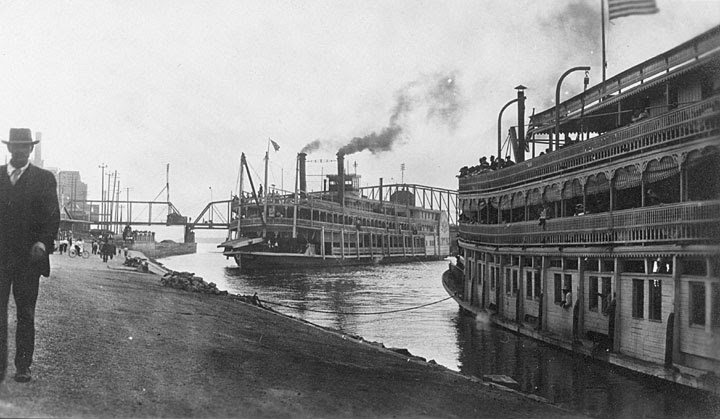
Every summer and fall, La Crosse hosts the arrival of steam-powered riverboats.  Through the years, I've enjoyed seeing The Delta Queen, the American Queen, Queen of the Mississippi and our very own over-achiever -- the La Crosse Queen.  Today's steamboats -- with elegant woodwork, calliopes and steam-powered stern paddle wheels are meant to replicate the Victorian Era steam paddlers of old.  But while they look the part, they are anything but like the steamboats that traveled the Mississippi River during the 1800's.

For many years, boat travel on the Mississippi River was a slow affair, with products mostly traveling down river on flatboats and keel boats.  The only way to move things up river was to use poles -- and push -- and that meant a large amount of time and money.  So the development of steam to move people and goods upstream helped create a new economy and many new river towns, and brought fabulous luxuries to the settlers.  Suddenly, travel on the Mississippi River was no longer a one-way route!

To understand what traveling on the Mississippi River was like during the early 1800's, you need to know that there was little reason to travel this far north on the river.  In the late eighteenth century, most river travel was on the eastern rivers of the United States and the lower Mississippi River between New Orleans and St Louis.  Between sandbars, strong current and hostile Indians, travel on the upper Mississippi River was no sure thing.  There are accounts like this from the La Crosse Historical Society that paint a very rugged and dangerous country:

"The whole country west of the Mississippi River was in the undisputed possession of the various Indian tribes when a few straggling settlements began to appear.  The Winnebago, Sioux and Chippewa Indians were the principal tribes along the river when the whole country from Prairie du Chien to Fort Snelling was one continuous wilderness.  The scenery of this region was grand and picturesque, but offered few inducements for settlement as long as it remained in the hands of a barbarous population."

"Fort Snelling (in Minnesota) was for two decennaries the great -- and in fact the only -- trading post in the Northwest.  It stood alone as the only civilized center in the midst of a great Indian territory, and within a few miles of the head of navigation on the Mississippi River."  

"The first steamboat to reach the post occurred in 1823; and the necessity of having provisions taken to the post would bring a boat up there only a few times every year, until 1845, when boats began to make regular trips to the fort."

With continued expansion to the west -- including growth in areas like Dubuque, Prairie du Chien, La Crosse and St. Paul --  steamboats were becoming a familiar site along the river.  But they weren't the kind that visit La Crosse today on a regular basis.  These were flat boats -- called packet boats -- which carried crops up and down the river.  In fact many river towns were built near plantations and farms to make getting crops to packet boats easier.  La Crosse was one of those towns.

From the La Crosse Historical Society --

"La Crosse is exceptionally well located for river trade.  The bluffs come close to the river's edge both north and south of the city.  The bend of the Mississippi River as it rounds the end of Pettibone Island just above the mouth of the Black River causes the channel to flow along the eastern shore where the levee is deeper for boat landing."

"Indian trails from northern Wisconsin centered at Prairie La Crosse while the junction of the La Crosse, Black and Mississippi Rivers formed a break in the means of transportation and made the location a cargo-breaking point."

In 1824, Congress passed legislation to improve the navigation of the Ohio and Mississippi rivers by making rivers more accessible -- removing sand bars, dead trees and snags.  Part of the process was the development in 1829 of another type of steamboat called the snag boat.  These boats were to find sunken trees, stumps or boat wrecks -- and remove them.  With storms and unpredictable current, the Mississippi River was constantly changing.   So snag boats were a very important improvement that allowed continued expansion along our great river.

As the river conditions improved and more towns popped up along the river, the need to bring people up the Mississippi River grew.  In 1823 the small steam packet Virginia became the first boat to travel from St. Louis into what was called the Minnesota Territory, carrying a trickle of what would soon become  a deluge of immigration.  An interesting side note -- also on board the Virginia was Captain William Clark of the famed Lewis and Clark expedition.

 
Early passenger travel was not a pleasant experience:  many of these immigrant families traveled in horrible conditions.  Among them were cramped spaces, often among cattle and pigs.  Passengers were exposed to diseases and enjoyed few luxuries.  Despite these conditions, steamboat travel opened immigration to settlers and their children.  The speed of travel made it possible for families to travel together, rather than have the father leave loved ones behind while exploring the wilderness with the hopes of returning for them much later.

As the years passed, steamboat travel for passengers became better.  Boat builders added more luxuries, making the experience something to write home about.   Again from the La Crosse Historical Society --

"The saloons of the boats were highly decorated with brilliant if not always artistic paintings.  Music was highly attractive to the passengers.  As brass bands were too expensive , a colored stringed orchestra was usually to be found in the main cabin.  These Negroes also worked as deck hands when unloading or loading the boat.  Six or eight Negroes who could play the banjo, violin and guitar, as well as sing, and who were also barbers, waiters, baggage hands were hired.  During their time off, they furnished music and received a little extra pay for it.  It was about 1879 that the first steam calliope was heard on the upper Mississippi."

"Three good meals were served on the boats each day, and the passengers were welcome to eat all they wished.  This was quite a contrast to the lower river boats, where passengers were expected to furnish their own food.''

"In the days of the keenest competition, all this and dancing was offered at the lowest prices, each company trying to outdo the other in an effort to gain trade.  They went so far as to keep agents at the railroad stations to persuade passengers to take their particular boats."


The glamorous style known as "Steamboat Gothic" attracted pleasure-seekers and wealthy travelers.

Herbert Quick wrote in "Mississippi Steamboatin' " -- "To mid-westerners in those days cabin passage on a steamboat was the ultimate in luxury.  More comfortable than their setting rooms and more ornate than their parlors, these travelers had never seen anything like it before.  The wooden filigrees that stretched down the long aisle in a tapering vista illuminated by glistening cut-glass chandeliers; the soft, oil paintings on every stateroom door; the thick carpets that transformed walking into a royal march; the steaming piles of food on the long linen cloth in the dining rooms, and attentive waiters standing with more food and desserts -- neither home nor hotels were ever like this!"

As interesting as it was to travel on a steamboat, they could be quite dangerous.  On the upper Mississippi River it was common for rival steamers to race, beam to beam, down narrow channels.  Their captains could ignore safety measures and occasionally ram their competitors to gain an advantage.  Boilers -- pushed beyond their limits -- occasionally blew up and killed passengers.

A well-known steamboat in this area -- the War Eagle -- burned at La Crosse in 1879 at the confluence of the Black and Mississippi Rivers with the loss of two lives and $215,000 in property damage.  A picture of the boat is painted on the side of a building near downtown.

I've often wondered about cost -- both to build one of these boats and to be a passenger.  According to early record keeping, the average steamboat -- accommodating 200 cabin passengers and 100 second class passengers would cost from $25,000 to $30,000.  Monthly expenses for the crew, food, wood and sundries were $11,500.  Passengers would pay $5 for a cabin when traveling downstream from St. Paul to La Crosse.  Traveling upstream was a little more expensive -- $6 from La Crosse to St. Paul.  The profit of the average boat for a season was about $56,300.

The average life of a steamboat was eight years.  Based on the costs of operating the boat and the large profit being made, it's easy to see why river traffic increased so much during the mid 1800's.

As quickly as they became popular, however, steamboats began to lose their appeal as railroads gained popularity.  In the year 1830, there were only 23 miles of tracks in the United States.  By 1880, there were 93,000 miles of tracks.  As the country moved into the 20th century, the invention of cars, trucks and airplanes signaled the end of steamboat traffic as a preferred means of transportation.

In the early 1900's, the Great Depression, the explosion of shipbuilding capability on the river because of WWI and II, and the rise of diesel tugboats finally finished the steamboat era.


*    *     *     *     *


As the great boat slowly pulls out from the landing, the quiet of the morning is disturbed by the mournful sound of the American Queen's steam whistle.  In my mind's eye, I image the captain in the pilothouse, grabbing the whistle handle and slowly pulling down against the pressure of the steam valve.  The captain's face is lit by the lights of the boat's control panel and the early morning glow of lamps in Riverside Park.

Another low moan can be heard from the gilded steam whistle atop the smokestack bonnet.  After blowing the long blast, the captain pauses to wait for the echo which comes shortly from the surrounding bluffs, barely visible in the early morning light.  It is almost like his last pull on the whistle has awakened the ghosts of previous steamboats that traveled this river almost 175 years ago.  The echoes continue until the last ghostly specter has vanished like a warm river mist.

And with a slight turn to the left, the American Queen continues its journey north through Winona, Wabasha, Lake Pepin and eventually St.Paul.

Life along the Mississippi River has inspired many people:  Mark Twain, with his wonderful stories of Tom Sawyer and Huckleberry Finn; and one of the greatest American musicals, Show Boat.  Both of these examples show the drama that lived in the daily lives of people along the river. “Ol’ Man River” and other songs are poignant reminders of how rivers wind their way through people’s lives as well as the American landscape.

"In my dreams I seem to hear a whistle shrill -
Like the whippoorwillin'  of the whippoorwill.
In my ears I hear it ringing
And the past to me it is bringing.

It reminds me of the dear old past
to me it is bringing.
It reminds me of the dear old Mississippi.

When I loaded cotton on that
stern wheel ship
They were the happiest days
there's no doubt.

On the Mississippi."

-- On The Mississippi, Ballard MacDonald, 1912


Of Flowers, Pants and Family

FLOWERS HAVE A  LANGUAGE ALL THEIR OWN -- the Victorian Age called it floriography -- speaking to us through their vibrant colors, dramatic ...

Blog Archive