Wednesday, April 3, 2024

Two Countries -- One People

It took me a while to appreciate what I was seeing and hearing.  But after about ten minutes, I was all in.

On stage, Elvis, wearing a red velvet jacket and tight black jeans, leaned back and grabbed the microphone, his hips gyrating to the beat of "Jailhouse Rock."  Seventy-nine years ago, this performance would have been described as an attempt to rouse the sexual passions of a teenaged youth. "Sexual self-gratification on the stage," and "animalism that should be confined to dives and bordellos," wrote critics of his grunt and groin antics.  

Tonight, at a much more subdued roadhouse called Leo and Leona's, it was just another performance to a group of 60 year old's looking for a glimpse of Garry Wesley's Las Vegas act.

It was both entertaining and a little weird to listen to songs  I had loved and known all my life.  Weird because while the vocals and movements were Elvis perfect, I realized it was someone else who had dedicated years and years of his life imitating the persona of a much-loved performer who had died forty-seven years ago from prescription drugs and too many potato chips.

What possesses a man to wear a rhinestone jumpsuit and 70's glasses, dye his hair black, grow sideburns and modulate his vocals to sound like someone else?

I don't honestly know.  But maybe playing with the legendary Jordanaires, before a crowd of 30,000 in Santiago, Chile had something to do with it.  Or, -- in our case -- a crowd of maybe 30 die hard Elvis fans at a roadhouse located in tiny Newburg Corners, Wisconsin on a cold Saturday night in March.  Either way, it was entertaining and worth the price of admission.  Viva Las Vegas, baby!  Or as the song goes:

"There's a thousand pretty women waiting out there

And they're all living the devil may care

And I'm just a devil with love to spare

So Viva Las Vegas

Viva Las Vegas."


Joining us tonight were two visitors, enjoying Leo & Leona's for the first time.  They had traveled more than 4,365 miles (7,025 km) to spend time with Liz and me before continuing on their journey to better music and better weather than what they found in Wisconsin.

How we met stems back to our decision ten years ago to join La Crosse Friends of International Students, a cooperation with UW-La Crosse, Viterbo University and Western technical College to promote cross-cultural understanding between international students and La Crosse area residents.

I have posted about the students we have met through this program before.  It has turned into one of the best decisions we have made since our boys went to college and found jobs.  With more time on our hands, we got lucky when we decided to sponsor Jae Hyun, our first international student from South Korea, who eventually earned a four year degree from UW-L.  

It was such a fun experience, we decided to host more students from China, Sweden, Denmark, France, England and Japan, to name a few.  Most of these students didn't spend a year, much less four years on campus.  Many stayed only a semester, practicing their English and enjoying an American lifestyle and education.  Many traveled to Chicago, New York and Los Angeles -- but we did our best to highlight some of the simpler things Wisconsin has to offer, like local restaurants, football games, hiking on our bluffs or boating on the Mississippi River.  And the quintessential college necessity -- food.  Holidays, birthdays and gatherings around the table were some of our best times together.

During the fall semester of 2021, we met Katrin Latza, a student from Frankfort, Germany, who was an pragmatic young woman who flew around the world as a stewardess for Condor Airlines when she wasn't going to university to become a middle school physical education teacher.  She had many talents, but among those we enjoyed was carving a pumpkin, a healthy taste for beer and the ability to fashion together table linens that would be placed at tables much nicer than the one in our dining room. 

Like so many of our international students, she left after one semester.  But to our surprise, she returned twice to visit friends from college and to see us.  She even coordinated (with her mother) the purchase of an authentic German dirndl dress for Liz to wear at last year's Oktoberfest celebration in La Crosse.  Attired in her new dress -- surrounded by festive horses, bands, and floats --  Liz danced and drank with enough einsteelung to make her German connection proud.

And then last month, Liz received a message from Katrin that her parents were planning a trip from Chicago to San Francisco in March, and they hoped to stop by our humble abode for a visit.  They wanted to see where she went to school and lived while at UW- La Crosse.

Our initial reaction was "Great, it'll be like seeing Katrin, only older!"  Then on second thought, "What are we going to do?  It's March and everything we like to do and see looks like crap.  The only thing happening during their time here is March Madness, and they probably don't like basketball!  Why couldn't they come in June or July when we can show them how beautiful La Crosse is, and take them out on the boat?"  On top of everything else, Liz was recovering from her second knee replacement, and we didn't know how she would be doing.

After a shot of Jägermeister, we collected ourselves and told Katrin we would love to meet her parents, Guenther and Kerstin Latza.

Liz, with her usual enthusiasm for all things fun, sat down and searched the internet for what was happening in La Crosse the weekend of March 16th.  The options were sparse to say the least.

"La Crosse Events in March" showed nothing.   Nothing happening at the La Crosse Community Theatre either.  The La Crosse Center had announced the inaugural Pabst versus Old Style contest, with local bands playing (none of which we had ever heard before.)  I could only imagine a sparsely attended event by twenty year old's with bad hair and poor taste in beer.  Not the kind of thing you wanted to show someone used to Frankfurt's more sophisticated night life. 

Katrin had made her own list of things to show them -- Grand Dad's Bluff where you can see three states and the Mississippi River basin.  A walk along Riverside Park with a view of the Mississippi, Black and La Crosse rivers.  The Bodega Brew Pub with over 400 bottled beers and 20 taps.  And The Pearl, her favorite ice cream shop on Pearl Street.

We finally decided on a full day of ordinary things,  determined to make the best of it.  La Crosse is lucky enough to have a small museum downtown called the Dahl Auto Museum, which is really a cool place if you liked vintage cars.  The Dahl family has been in the automobile industry for over a century, and inside, we were able to learn about the evolution of Ford cars through the last ten decades.  I've been in the museum a number of times, and I still enjoy seeing the Model T's from the early 1900's, the Fairlane's and Thunderbird's from the 1950's and the awesome Mustang GTO's from the last decade.

From there we drove to the lookout over Grand Dad's Bluff, where they could see the entire city of La Crosse, the river and bluffs that are key to our Driftless Region.  Our distinct topography represents a small piece of the Upper Mississippi Region that  was miraculously left untouched by glacial erosion and deposits.  As a result, our area has become a destination for people looking for examples of the natural, rugged terrain that once spanned the upper Midwest.

Our next stop was the University of Wisconsin- La Crosse, which -- because it was spring break and empty of all students -- resembled the aftermath of some terrible catastrophe that decimated humanity.  Walking through the empty campus and their vacant buildings, left me wondering if one misstep would unleashed hundreds of zombie students from a locked, basement laboratory.   Equally disturbing was the realization that UW-L's chancellor had been fired recently, after it was discovered he was making porn films on campus with his wife (as far as we know, no students were involved).  I still don't know if Guenther or Kirsten believed us -- somethings get lost in translation, and I wasn't about to act it out.

We finally stopped for a quick drink at the Bodega Brew Pub, where you can always find a beer you will like.  Unfortunately, we didn't have time to get one of their special Bavarian twist pretzels.  But we did have the time to watch the Wisconsin Badgers and Purdue Boilermakers battle it out to an overtime win for Bucky in the Big Ten Tournament.  My joy was short lived, however, as the Badgers quickly lost the following week to the lowly James Madison.  But it was great while it lasted, as was the Harp beer on tap.

Our final choice was a concert Saturday night at Leo and Leona's where some guy named Elvis was performing his greatest hits...


I took my spoon and carefully cut the small apricot-like fruit which was soaking in Jack Daniel's Winter Jack liqueur.  Moments before Guenther, Kerstin, Liz and I had raised our wobbling little fruits in a toast to a resounding "Prost!" before taking a bite and sip.  
The sweetness of the fruit and the warmth of the whiskey was the perfect contrast to the sting of the Jack Daniels.

Earlier in the day, Kerstin had informed us that this was known as mispelchen, a popular digestif served in certain Frankfurt cider houses at the end of meals.  It was usually served with apple brandy, but we improvised with the Jack Daniels they had picked up at Festival Foods in the village.  It's a  drink that is served with a small loquat fruit at the bottom.  It was new to Liz and I, but apparently it is quite popular in Germany, even though the fruit is not native to the country.  Somehow it made its way from Asia to Spain and France to Germany, where it is enjoyed by many.

All I know is that it WAS tasty and the perfect ending to our meal of  scalloped potatoes, carrots and pork tenderloin and another German favorite -- semmelknodel, or bread dumpling.   We never know what to serve our international students, and Guenther and Kerstin were no different.  Hopefully they enjoyed it as much as we did the mispelchen and semmelknodel.

In fact, we hope they had enjoyed their time in La Crosse.  

We found out that our conversations were more important than the things we were doing.  Guenther -- like Katrin --was never one without words.  Over a few beers, I discovered his view on immigration, schooling and raising children are the same as ours.  The same problems exist in Germany, as they do here in the United States.  The solution is never the government, but the everyday people who have to work for a living.  

Other things we agreed on -- Nazareth, Def Leopard, Bon Jovi and Billy Idol.  When traveling to other countries, the strangest things are the bathroom and kitchen.  And the bedroom, where we discovered the answer to marital fighting over who gets the bed covers is two single-sized duvets.   America has a lot to learn when it comes to the bedroom, but it's not the sex.

We also talked about their trip.  At least we were able to give them a few nights not spent sleeping in a hotel or camper.   We discussed their plans for stops in Denver, the Grand Canyon (and other national parks within reach), Las Vegas, and San Francisco.  In the place where Tony Bennett lost his heart, they were meeting their daughters for a trip down scenic Highway 1 to Los Angeles before flying back to Frankfurt.

I always believe that if I am having a good time doing something, the people I'm with usually do, as well.   And even though we were worried about showing them a good time, we quickly agreed that despite being from different countries and speaking different languages, our similarities were far more numerous than our differences.

The world would be a better place today, if we could all spend a weekend together -- especially if it included a whole lot of shakin' down at the local roadhouse.

Danke für eine gute Zeit!


Wednesday, January 31, 2024

Why Memories Matter

" Life can only be understood backwards, but it must be lived forward."

-- Soren Kierkegaard


The wine bottle was tucked neatly between the Dickens Christmas Village firehouse and bookstore, having been forgotten all these years in our basement root cellar.  It had been more than forty years since I had poured the last glass of wine from its glass, potbellied mouth.  I worried that it would shatter at the slightest touch.

I reached in and extracted it, careful not to knock other items off the shelf.  I blew the dust off the bottle and see a number of rolled, yellowing papers inside.  It is stuffed with letters from Liz -- before the romance and courtesy of letter writing was replaced by hurried, efficiency-obsessed text messages, emoji's and emails.  

I leaned back against the cellar door and looked at the bottle.  Inside was a treasure trove of youthful feelings; the doubts and fears of two college-aged kids trying to manage a long distance affair.  An unlikely meeting at a bar in La Crosse had somehow continued -- beyond the walls of Dells Bar to Conklin Place in Madison, then to  Grand Rapids, Michigan.


Later, after retrieving the old letters, I laid them out and with great anticipation start reading.  It's like I stepped into a Time Machine -- we were still young, in college and just starting to plan our future.  

It was a time of innocence and longing.  

This one, written in red ink on toilet paper talks about a hard day of work and coming home to an empty apartment, wishing she could see me.  Another one talks about going out to eat with her room mate, then going to a movie called Ghostbusters.  "That was a great movie!" she writes.  Or another one talks about visits to Readstown, DeSoto, Viroqua and Stoddard to complete her community health nursing visits.  That would be while she was still a nursing student in college.

Someone with a sense of humor could see these letters making a romantic comedy.  A romantic dreamer, with a love for storytelling meets a beautiful, small town girl with a calling for compassion.  It would be called "Pages and Patients:  When Nurse Meets Author."  

Well, maybe not...

I read through others before coming to one of my favorites.  It was written after our first meeting.  I was home from college, hanging out at a bar with friends, and I saw a pair of eyes that were so intriguingly deep that it took me an entire weekend to figure out what had happened. They belonged to a brown haired girl who was finishing nursing school at Viterbo College.  I walked her home after bar time, and my life was never the same.

But in reading her letter, I discovered she had an interesting recollection.   It began --

"You probably don't remember me.  But I'm the girl you walked home on the fateful Friday night from Dell's.  Ring a bell now?"  

Rang more than a bell!   

"I guess I'm writing to apologize for my behavior that night.  I was a little out of sorts.  I'm not usually like I was that night..  I 'm usually extremely quiet until I get to know the person, which takes a while for me.  I also wanted to thank you for walking me home.  You really didn't have to do that.  It was nice though.  I wish i could say I enjoyed our talk on our way back, But I really don't remember what we talked about."

How funny is that?  The woman of my dreams, and she doesn't even remember me.  She went on to say that she would like to see me again if I was ever in La Crosse, and to look her up.  

Well, the rest -- as they say -- is history.  

In general, these letters expressed our worries, hopes and fears as we finished college, found jobs and dealt with the difficulty of maintaining a relationship separated by more than 200 miles.  As I read these letters, I am convinced it was overcoming this distance that kept us together.  It forced us to call each other late at night, usually after spending the night working, finishing homework or returning from the bars.  These letters were another way of putting our feelings for each other down on paper.   Absent each other physically -- it formed an unbreakable bond that is still present today.

I am so glad I saved these letters, and love the memories that formed the basis for our relationship and shaped our lives going forward.


Seems like someone said memories are like a hot cup of homemade chocolate.  Yup, it's an experience for the senses.  The comforting warmth you feel when taking a sip and the aroma of rich cocoa.  The velvety texture as it slides down your throat. 

Life is full of them,  some remembered better than others.  Our childhood, friends, college, parents and grandparents, weddings, birthdays and funerals.

Once upon a time, I've been accused of living in the past.  Which is not true because the person who said it was Liz when we were dating.  In my defense, I don't know how you can get to know someone without talking about your past.  Your friends, favorite things to do and places you have visited.  I feel like memories are who you are.  And paradoxically, provide hints to who you are going to be.

A problem develops when you are not happy with your life or relationship and constantly think your life was better when you were making all of those memories.

Over the holidays, I was reading a great book from Blake Crouch called Recursion.  Blake is a young author who writes about the future -- genetics, time travel and alternate realities.  They are fun and thought provoking.  His books have been made into television and movies.

In Recursion he's writing about memories.  The premise is that there is technology available that allows someone to travel into the past and relive a significant memory.  Not just remember it, but actually go back and be a part of it --carry on the conversations, walk the streets and participate in events as they unfold in real time.

What a great premise!

 But like all good intentions (to help a mother with Alzheimer's) it is sabotaged by bad people who want to changed the past to make a better future.  Unfortunately, like readers of any good time travel story know, you can't change the past without unforeseen things coming back to hurt you in the future.

Forget the dystopian undertones of Recursion if you can.  It will always be tempting to back back in time and change the future for the better.  There's going to be disappointments and failures in life that you would like to change.  A career path that didn't work out the way you thought it would.  Maybe someone's unexpected death.  Who wouldn't want to save a child who is killed in a car accident or a soldier who never returns from war?

Memories strengthen our sense of identity and bond our relationships with family and friends.  It gives us a framework to understand who we are and how we got here.  How many times do we look forward to getting together with family over the holidays because we had so much fun last time.  We remember the fun we had playing cards, building puzzles or watching a movie -- and want to do it again!

Which is why it's so devastating to see someone who suffers from a disease like Alzheimer's.  Not only don't they know who you are, but they struggle to understand who they are.  

Am I the only one who worries about some day not recognizing the face in the mirror?

Most days in our lives are uneventful, where nothing happens.   We get up in the morning, go to work and go to bed in the evening, with little to distinguish it from the next.  None of them remain rooted in our existence, beyond maybe a color, a sound or a taste.  It's when you step outside this routine that you create an impression that adds a dress to the color blue, a catchy phrase to a popular tune, or a new wine to your palate that makes it memorable and lasting. 

I'm in my seventh decade, and have had people and family that are as much a part of me as my hands and feet, and yet I remember so little of our times together.  It's one of the reasons I write and take pictures, cramming books and albums full of smiling faces, beautiful sunsets and time spent on the river.  I want to enjoy these memories and one of the best ways is to preserve them.

A single picture of our parents or our childhood bring back a flood of memories.  I can't say it better than Simon & Garfunkel who sang a song called Bookends, in which they sing - 

"I have a photograph.   Preserves a memory.   They are all I have that's left of you."

We learn a lot from our memories.  Time moves many of them into a box where they are kept until we find the right key and open it.  And the discovery of these letters in the cellar has just unlocked many of them, from a time when Liz and I were just finding our way through life, together.

If I was a character in Crouch's book, I would have no trouble going back to relive this memory:


The first time I met her was at a second rate bar on Third Street in downtown La Crosse.  She was hanging out in Dells Bar, and judging from the friendly conversation with the bartender, it wasn't her first time.  As it turned out, it was her birthday and the bartender looked like he had other intentions besides keeping her glass full.

My intentions, on the other hand, were to get her coffee-colored eyes -- and preferably the rest of her -- to wander to my side of the bar.  I thought I'd never get her attention through the crowded bar, so I sat there looking at her with a frothy Old Style in hand.

I was back in town with some friends who were more than willing to indulge in some barhopping.  The night was young, and so were we...

At almost 2:00 a.m., the bar was closing and I walked past her bar stool, leaning forward and told her I'd wait for her outside the bar.  On the juke box, Michael Jackson was singing "Wanna Be Startin' Somethin'" and I stepped out into the crisp summer night.  After the sweaty confines of Dell's cramped bar, the cool night was a shock to my semi-inebriated system.


I had told my friends to do their own thing.  Doug had found some girl he knew and Paul (who was my ride home) had slapped me on the back and vanished.  While waiting outside, I paced back and forth, taking an occasional look through the dirt streaked window to see her still sitting at the bar laughing and talking to the bartender.  

"What the hell am I doing?" I thought.  "I've never met this girl before.  I don't know her name and somehow I've got the nerve to tell her to meet me outside?  This is crazy!"

I stared at my feet, willing myself to wait a few more minutes before giving up and heading home.  It was bar time, and people were streaming from nearby bars like drunken vampires leaving their coffins at sunset.

Suddenly the sound of shoes coming from Dell's doorway caused me to turn around.  In the time it took for me to catch my breath, my eyes wandered up her noticeable curves, lingered on her small mouth and finally found her eyes, which were now searching left and right before settling on my face.

"Hey," she muttered as I grabbed her waist.  Small curls of light brown hair framed her face and neck.  My hands had touched a glimmer from heaven and I was determined not to let her get away.

"Let me walk you home," I said pushing her through a mass of bleary-eyed blood suckers.


          *          *          *


The path we chose to get to her apartment meandered through the excitement and buzz of various downtown crowds to the quiet, dark streets of more residential neighborhoods.

I discovered she was a Viterbo nursing student who had gone downtown to celebrate her twentieth  birthday with a few friends.  Where those friends were and why they left her alone with a bartender was a mystery I would never know, but at a minimum, I figured she needed someone to make sure she got home safely.  

And who better to do that than me -- a La Crosse lifer who was attending journalism school at UW-Madison, but home for a long summer weekend?

As we walked through sporadic pools of yellow light coming from the street lights, I found myself fascinated by this girl.  She was beautiful and friendly, but difficult to figure out.   Much would be said in  the coming years, but to this day, I don't know what it was that kept me with her the whole way home.  Perhaps it was something I saw in her soft caring eyes which told me this wasn't' what she was really like...


    *          *          *


The grass was wet with the dew of the early morning, as I rolled her over and kissed her on the lips.  I loved the smell of her hair --  vanilla mixed with the odor of cigarettes that still clung to her blouse like grapes hanging on a vine.  My hand found her face and I traced the curve of her nose.  

"Am I going to see you again?" I asked as we laid on our backs, watch stars fade from sight.  We were outside her apartment, still wrapped in the darkness of an early morning chill.  I could see the hard shapes of houses and trees distinguishable from the fading night sky.  Within the hour, a new day would begin, chasing the shadows and mysteries of this evening away.

"I don't know," she confessed with very little conviction.  She was lacking the energy to put much into her response.  "I'll have to let you know."

Later, as I walked home, I kept remembering her response to my question.  It had been a long night of pleasant, but unexpected discovery.  Someone once said that if you try too hard, you won't find the one of your dreams.  It happens when you least expect it. 

What if I had left early, or my friends and I had gone to a different bar?  Fate, or coincident -- call it what you will -- had played a role in tonight's encounter.  Relationships had come and gone before, but this one felt different.

I dug into my pocket and pulled out a slip of paper with her phone number written on it, and thought what it would be like to see those brown eyes again.

The start (of rest of our lives) was just a sunrise away.


Sunday, May 14, 2023

Bionic Woman


The nurse gently removes the bandage, revealing a scar, red, raised and firm to the touch, running from mid femur over the knee to the upper tibia.  Staples, holding the surgical incision together, brought to mind a zipper without the pull.
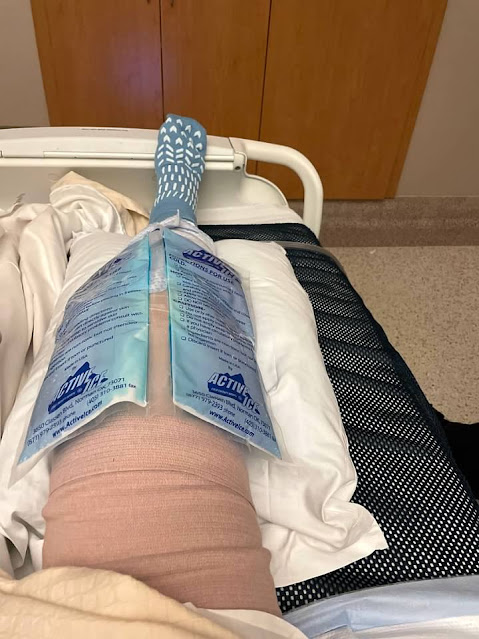
I could read Liz's mind as she looked down at her leg.  "As if my legs aren't bad enough, now I have this ugly scar making them worse."  To her, the scar represents some unsightly disfigurement used to portray evil in horror films, comic strips and fairy tales.  At a minimum, it meant no more shorts or above-the-knee skirts.

My heart, goes out to her, as she prepares to face another challenge.  Her knee had been a problem for some time, but to some extent tolerable.  Recent activity at a local gym had aggregated the pain in her knee, forcing her to try different medications, massages and physical therapy that did nothing to help alleviate her pain.  At best they provided temporary relief, but nothing to allow the normal functioning of her knee.

In the end, she saw a doctor who correctly identified it as a quality of life issue.  Did she want to lead a normal life of activity or avoid activities that caused her severe pain?  In the end, it was an easy decision -- if it meant an end to the pain, she was all in.

Surgery was three weeks ago, and everything had gone well.  Today's visit was all about taking off the dressing and getting a first look at her bionic knee.

The nurse, her name badge said "Amanda," gave an approving look as she moved Liz's leg, observing the tissue surrounding the incision site, looking for signs of infection or unusual swelling.  

"That looks really good, Liz," Amanda says, pushing back in her chair.  "Any pain or difficulties moving your knee -- outside of what's expected?"  She flashed a smile only a nurse can give.

"Not to the knee," Liz's attention remains fixated on her knee and the scar, "but there's an area around my groin where they tied the tourniquet to shut off the blood supply to my leg that really bothers me.  I'm hoping that gets better with time."

I am sitting next to Liz, having been part of her consult, surgery and recovery process.  I don't know if I'm much help.  She will be the first to tell you how I get light-headed whenever knives are involved -- in movies, opening a frozen pack of hash browns and a chocolate bunny injury that involved  a deep cut to Sean's finger and a flash of bone.   It was bad enough for me to calmly drive him to Urgent Care and confirm that he needed stitches.  Unfortunately, I had driven to the wrong clinic.

I blame it on my extra-ordinary ability of feel the pain of others. 

I know you can laugh and think I'm joking, but I'm not.  I'm not suggesting I have any kind of super power, but I've always felt like someone's pain was mine -- like one of our international students deciding to have surgery on a very sensitive area of the male anatomy.  Just thinking about the procedure makes me want to sit down.  My son seems to think I'm not a very empathetic guy, but he is wrong.

As if knowing this amazing ability of mine, Amanda -- still smiling -- reaches into a nearby drawer full of bandages and other medical necessities, and discretely takes out a staple remover.  Her slight of hand to minimize what she is going to do reminds me of numerous examples of a doctor or nurse playing hide and poke with an eight-inch needle that is about to be plunged into your backside.

 "This is the worse part of today, Liz," Amanda assure us, as the remover grabs the first of twenty-five staples and quickly pulls it from her tender flesh.


Nursing is one of the most demanding professions in the working world, requiring long hours, physical effort, and a high level of skill and professionalism.  I know, because I'm married to one.  This year, Nurse's Week kicked off on Saturday, May 6 and continued through Friday May 12.  

It's unfortunate that nurses don't get more recognition for their work, other than an occasional card, some flowers or maybe if they're lucky, a tumbler with a heart on it.  Not much respect for someone who has to watch a patient die, work weekends and holidays, clean up piss and shit, or tolerate verbal and physical abuse from patients and sometimes doctors.  And in many cases, go home and take care of the family, before doing it all over again 12 hours later.


I mention this, because I was given a "certificate of nursing" by Liz before her knee replacement, and while it was appreciated and given as a good will gesture of knowing what was involved, I had no clue of what was coming.  

And I had it easy --  I only had one patient, I was in the comfort of my own home and bed, meals were pre-cooked and ready to eat, and "real" help was only a question away.  But it every way, the time I spent taking care of, and helping Liz through the first month of her recovery, was a testament to her profession.  

Sleepless nights?  Check!  

Lots of lifting and attending to basic daily activities?  Check!  

Monitoring medications that were needed at specific times?  Check!  

Being concerned with my patient's well being?  Check!  

Finding my own time to eat and shower between patient care?  Check!  

Causing physical pain and suffering, even though you know it's the best thing to do?  Check!

Tolerating the use of enough cold and ice to think I was living in the Arctic?  Check!

Did I mention sleepless nights?  I was so tired that I couldn't sleep.  Have you ever experienced that? 

I can remember as a teenager, driving back from California with my best friends being so tired I couldn't think straight. It was so bad, I had to pull over even through we were only an hour away from home after driving for two days straight.  And coming back from a snowy Packer football game (a loss to the Atlanta Flacons in the playoffs) at four o'clock in the morning and trying to talk.  The words were coming out, but they weren't making any sense.

During the first week after her surgery, I would sleep for a short time then wake up, even though I was  dead tired.  So I grab a book to read until I can't remember what I just finished reading.  Then toss and turn some more.  I think part of the problem was having a baby monitor next to my bed so I could hear her sleeping in the room downstairs.  While the monitors worked really well -- I could hear every concerning squeak and thump coming from her bed -- I was always worried I wouldn't hear her when she wanted me.  And I had turned on the alarm (every three hours) so I wouldn't miss her shout when it was time to get more ice and another round of "guess which pill I have in my hand."  

I completely understand how someone could be given the wrong medication by a nurse in the middle of the night.  I may have done it for all I know.

But it wasn't all bad, because the best part of being a night nurse?  After struggling to get my arms in my robe and stumbling down the stairs (with both eyes closed) I would walk into her room where I could see her smiling face, caressed by the glow of a subdued night light.

At moments like that, I think I would have done anything for her.  Well, maybe not eat brussle sprouts or beets, but pretty much anything else.  There is a sense of purpose -- in the dead of night, or when you're drying her hair or helping her put her socks and shoes on -- that a normal job doesn't contain.  There may be excitement that comes with many jobs, maybe even real accomplishment, but when it comes to feeling like you're making a difference in someone's life, I think nursing has them all beat.

It reminds me of when our sons were born and being able to comfort someone in distress.  You realize, the little baby you hold in your hands, crying desperately for that bottle of warm milk, needs you.  Or the little boy, with tears in his eyes from a skinned knee, needs a hug and your assurances that everything will be ok.  Or the young man who calls late at night, his voice sobbing with  pain after breaking up with a long time girl friend, needs you to tell him the pain will get better and that he will find love again.

And in Liz's moment of need, I was determined to be there for her.


"If I could do this for you, I would..."

My words fall silent as she grips the bed covering searching for relief.

"Just twenty seconds more," I say, hoping to provide some near term relief.  We are finishing the third set of the prone hang, an exercise designed to increase the range of knee extension and activation of the quadriceps muscles.  The physical therapist claims it is especially useful after reconstruction of her knee. 

I think it could be especially useful as a torture technique -- Where did you hide the chocolate chip cookies?  -- I'm not telling!  -- WHERE ARE THE COOKIES?  Go to hell!  Then another five minutes of the prone hang for you! Tell me now before you die!

Everyone says the physical therapy part of any surgery is the worst.  It's true.  In fact, her doctor said his part in the knee replacement would last about two hours, hers would last for months.  The real success to getting better comes from going to your PT sessions and doing the exercises they give you to do at home.

They have names for different positions that remind me of yoga positions: 

Supine knee extension stretch.  (Big toe pose)

Standing tandem balance. (Feathered peacock pose)

Single leg stance with counter support. (Extended puppy pose)

I can imagine PT patients talking in the waiting room, comparing notes and various techniques.  

"Mine has me doing the supine 90/90 sciatic nerve glide with knee flexion," the middle age woman declares, her eyes wild with excitement.

In response, another woman trumpets, "I did the gastric stretch against the wall.  Try that sometime!"

"Oooo.  That sounds painful, if not impossible at my age!"

Liz has scooted up the mattress and is preparing for the last exercise of the night.  Unfortunately, it's one of the worse and maybe why we do it last.  I reach for the wide belt -- snapping it quickly like I learned in dominatrix school -- loop it around her ankle and give her the other end to hold.  I gentle raise her foot and leg into a 90 degree position and she grabs the other end of the belt, pulling it forward.

The goal of this exercise is to bend her knee past the 90 degree mark, then past 120 and eventually to 130  degrees.  Liz says a normal knee bend is anywhere from zero to 140 degrees, with a functional knee bend at 120 degrees.  A bend of 80 will get you up a flight of stairs.  A 130 degree bend will get you in a bath tub.  At 115, you can ride a bike.  

My watch shows thirty seconds, and I relax her knee.  "Oh my God," she moans as she turns her head to the side, her eyes holding back tears.  I thought these stretches were supposed to help, not facilitate another round of surgeries.  "Can you please rub the hamstring on my upper leg?  It is SOOOO sore."

I press my knuckles beneath her tail bone and run them down her leg, stopping just above her knee.  Then again.  With medium pressure, I use a long, slow, gentle stroke to help relieve the muscle fibers that are causing her so much pain. 

"Does that help?" I ask.

"Not really, but thanks anyway."

Failing at nursing without attending school shouldn't be a surprise, but I still feel a little disappointed I can't relieve her pain.   I know the surface of her body, but underneath the skin remains a mystery, much to to my dismay.  My watch reminds me to start again, so I gently bend the knee forward and tell her to pull.

"One more time -- you can do this."

Another round of "this" and she'll be doing the corpse pose...


I am sure I haven't earned my certificate of nursing, despite what Liz thinks, because my time "on the floor" only lasted a few weeks.  And even when I was helping, I was usually asking her what to do.  The last thing I wanted to do was mess things up and send her back to the hospital. 

I've discovered two things during the last six weeks:  Liz is a strong fighter and determined to get her knee back to a functioning level.  She's a great patient and listens to her doctor and therapist.

The other thing I know is how difficult it is taking care of someone.  It' a lot of work, and mistakes can be hurtful if not deadly.

It did allow me to fulfill my promise however, made thirty some years ago when I stood in a candle-lit church with the rain coming down, standing with her in front of God, family and friends and answered the question being asked by the pastor:  

"I take you to be my wife.  

To have and to hold from this day forward, for better, for worse, for richer, for poorer, in sickness and in health, to love and to cherish, till death do us part, according to God's holy law.  

In the presence of God, I make this vow."


Wednesday, February 22, 2023

Remembering The End of the World

"The Edge... there is no honest way to explain it because the only people who really know where it is are the ones who have gone over."

-- Hunter S Thompson, Hell's Angels


In March 2020, the United State went insane by shutting down its economy, shuttering businesses and telling all nonessential workers to stay at home in an attempt to slow the spread of COVID-19.  It failed worse than a reboot of Ghostbusters.  This month will mark the three-year anniversary of that event, one that I still see and feel by people wearing masks or catching Covid following exposure to the virus.  

Recently, the Twitter files identified major players who coerced and manipulated data to control our lives.  Their authoritarian control reached everything from restaurants and gyms to schools and sporting events.  I am amazed at how easily governments coordinated their efforts to change our lives.  Not just here in the United States, but everywhere -- Canada, Europe, Russia and Asia.  As a result, I'm suspicious of almost everything Washington D.C. does, yet even my suspicious nature was fooled by the daily death totals and case numbers that increased incrementally during the first few weeks of the pandemic.

iStock photo

So the damage was done, and in many sad ways, we're not coming back from it.  Grandparents and parents died, jobs were destroyed, and constitutionally guaranteed rights were lost.

Whether it's just therapeutic or something more aligned to making sure we never let it happen again, I wanted to take a look at some of the dumber things we did, which at the time, seemed reasonable considering the "risk" we were being told existed.  

We all should have known better.  We should have tuned out the COVID "experts" from day one and instead trusted our own observations and common sense.

"The End of the World as We Knew It" began for Liz and I on a flight back from California.  

For the first time, people were wearing masks on the plane, even though they weren't mandated.  We were sitting behind a young family, who's baby was not feeling good.  So much so that the baby threw up in the seat, and on mom who suffered through the embarrassment of trying to quiet the baby and having to clean it up.  My point to mentioning the incident is all I could think about was COVID.  Was this an early stage, and having been exposed were we the next to fall sick?  It was still early in the pandemic, and I hadn't been paying attention to the news.  In fact, the week leading up to the shutdown was spent in Malibu on the beach with one of our international students who had moved west to finish her college degree.  So -- like most of California's progressive population -- we were clueless about what was happening in the world.

I'm serious, (ok, Sleepy Joe) look at how screwed up California is three years later.

The week following our vacation saw businesses shut down, and sports were no exception.  A planned trip to Milwaukee to watch the Buck and Golden State was cancelled when the NBA shut down.  March Madness was just beginning, and I remember a game being cancelled at half time and the audience sent home.  My friends and I are quick to point out the computer projections that had the Wisconsin Badgers winning the entire tournament that year.  Unfortunately, no games were played, and we are left to wonder what could have happened.  ESPN, which relies on live sports to fill their programming, was left with talking heads filling hours and hours with mind-numbing analysis. 

I remember the day my office staff gathered around the reception area to discuss Wisconsin Governor Tony Evers' order to shut down.  It had been coming for days, as cruise ships and arriving travelers were being quarantined for weeks.  Leading up to the decision, people had been asked to wear masks when in public.  In fact, being the stubborn bastard I can be, I walked through our Festival grocery store without a mask and felt the eyes of others looking on in fear.  I follow rules -- contrary to what my wife may say -- but when signs on the business door said "masks recommended" I take them at their word.  Recommended is not required. their recommendation.  

But getting back to Evers' shutdown order.  Insurance was deemed an "essential business," which enabled our office to stay open, but with drastically different rules.  Three-quarters of our staff wanted to work from home (strangely they were the employees who either had young children at home or who stood around all day talking about trivia, television's The Office and how much they hated Trump), whereas the boss thought we should have some kind of presence in the office to answer phones and handle claims.  Even though the world shut down, weather, fire, wind and accidents continued unabated.

Those were long days, and I remember driving to work and not seeing a single car on the road.  We were available to answer the phones, but most of the time it involved our reactions to COVID.  We were living in a strange time and there was no shortage of opinions.  Everyone of those conversations ended with "Stay safe!"

It was decided that I should get the mail everyday (our post office still flies the banner reading "Heroes Work Here!").  Apparently, I am a hero too, and never knew it.  Outside of work, the days were spent watching television and adjusting to life inside your home or apartment.  

To separate weekdays from weekends, Liz and I would drive somewhere in the car to breakup up the monotony of our lives.  One weekend we drove up to Alma, Wisconsin and stopped at Buena Vista Park overlooking the Mississippi River.  It is the largest natural balcony overlooking the river, where on a normal day you could watch barges traveling up and down the river.  This day, there were no barges, but there was another warm body (as opposed to the walking dead you feared walking out of the sparse shadows of nearby trees) in the park who wandered up to his car and drove off as soon as we arrived.  


Believe it or not, a statewide radio station would play Badger Jump Around (played at Badger football games at the beginning of the 4th quarter) at 3:00 PM on Saturdays and asked people from around the state to "jump around wherever you are."  We were more than happy to comply with fellow non-vaxers -- on our pontoon boat and in the middle of the river.

With so few people driving, gas prices dropped significantly.  A quick drive across the river to a Winona "essential" gas station would provide cheap gas at only 99 cents a gallon.

Not being considered an essential business was never fully explained to us.  Like so many things the CDC told us, they were completely random choices that led to direct assaults on businesses and families.

Many small operators went out of business because they were not on the cherished E list.  Businesses like bars, exercise gyms and hotels.  But supermarkets, pharmacies and banks were essential.  Depending on where you were located -- even a few blocks -- sometimes dictated if you could be open or not.  It was insane!  And restaurants were given an exception as long as it was only take out.  I remember buying take out only because we wanted to support our favorite places to eat, and we didn't want them to fail.  

Everyone with half a brain knows if COVID was going to kill you in your favorite restaurant, it was going to kill you in Walmart.  

We all thought the shutdowns were temporary, but after Easter came and went with no changes, I began to doubt what we were being told.  I've never been a fan of our government agencies (beginning with an internship with the DNR in Madison, where the amount of time wasted talking about problems, but doing nothing to solve them convinced me to never work for its bureaucracy again).  So when reality set in and people dealt with this new normal, our lives -- more specifically the way we were allowed to lead our lives -- changed into something so strange that I can't believe it, even now.

Masks, safe distances and remote learning were as common as mud on a pig.  They were simple in design, but influential in attacking the nuclear family, religion and social interaction.  All of these events involved people being arrested and fined if they did not follow the rules -- but rules that were based on what?.

. Wedding postponements robbed newlyweds of one of the most enjoyable events of their lives

. Hollywood and Broadway went dark (and I don't mean Black History month)

. ZOOM meetings spread like the virus (later most of us would prefer COVID over another ZOOM meeting)

. Children were prevented from seeing elderly parents and grandparents (many of the elderly died in nursing homes and hospitals, alone)

. Schools chose remote learning over in-class instruction (and we have lost a generation to poor learning)

. People wore plastic bottles, oranges, and underwear on their face when they didn't have a mask

. People were ruthlessly fired from jobs because they were not vaccinated.    Many are still not allowed to return, despite worker shortages in the medical, airline and military fields.

. Outdoor activities were banned (a single person made the news when he was arrested on a California beach)

. Round dots, spaced 6 feet apart, magically appeared in grocery stores and government offices 

. Much to the dismay of hearing-impaired people, grocery stories installed protective plastic shields at checkouts to separate cashiers and shoppers

. Hospitals were furloughing nurses and parking lots were empty because they locked their doors to elective surgeries and routine checkups.

. Viterbo required masks to be worn during noon ball.  Some of us refused for over a year

. People were so desperate to get their hair cut, they called their stylist and got it cut in their garage.

. China's "zero COVID" policies resulted in apartment doors being welded shut for weeks or months

. Public bathrooms were closed, so people relieved themselves outside

. The  popularity of drive-by birthdays and anniversaries

. Christmas and Thanksgiving were celebrated without family (unless you were liberal and special)

. The news started every day with COVID data reports on deaths, hospitalizations and infections (only later did we confirm most of these deaths were with COVID not because of it).  Daily updates came from Washington, featuring President Trump and his administration.

. We developed a vaccine that prevented nothing; the "vaccines" now requires 4 different boosters.

. Long lines of people in cars, waiting to have a Q-tip jammed up their nose

. Toilet paper and hand sanitizer shortages caused grocery stores to ration items, and distilleries to forsake the smooth burn of liquor sliding down our throats, to the slippery feel of hand sanitizer on our hands.

. Lockdowns resulted in worldwide shortages of computer chips needed to make just about everything

. Churches were closed, so online services were held.  Communion was given in parking lots with your own wine.

. Voting laws were changed to allow COVID-free voting (and election fraud)


Three years later, have we learned anything from March 2020?

Based on the trouble I had researching some of the information used in this blog, I would say no.  Search GOOGLE for anything to do with COVID lockdowns, and you will get a long list of articles about COVID prevention and one-sided stories from the New York Times, CNN and Washington Times warning you of the dangers of the virus and the misinformation coming from FOX News.  It's as though everything we need to know about COVID and its related shutdowns doesn't exist.  

Let's face it, the truth about COVID is being deep sixed.

As a society, we still haven't accepted the errors of our ways.  The left's movement to divide our country has never been more evident.  Too many of us still forsake common sense and favor cruelty against our neighbors in the interest of safety.  It's obviously bad to lock people in their homes or to force people to mask and take risky vaccines because you don't want to breathe the same air as them.  Young people -- our most "enlightened and woke" -- are simply not capable of ignoring their "news" feeds and consistently show they have a hard time discerning the truth.

And finally, not one person responsible for the madness of 2020 has taken responsibility for their actions.  As a Christian, I think forgiveness is important to a good life, but it has to come with repentance, otherwise the same people will just screw us over again.

Don't hold your breath for Fauci, Biden, Trudeau, the CDC or the WHO to admit their actions had little to do with our safety, but an attempt at authoritarian control.  Legacy media and academia also failed us and little has changed in their behavior.  Calls for self-absolution by those who got it wrong, and accusations against us that got it right indicate they haven't changed at all. Until they are shamed and punished for their actions, there will be no recovery from these dark days.  

Perhaps it's still too soon  -- to close to the heart, too painful to admit, or still too political.   But as a worldwide society, we must stop being afraid of every airborne illness and hold some of those responsible for their complicit corruption.   Take a stand, speak it loudly and let people know it.

The future of our economic and social well-being demands it.


Thursday, November 3, 2022

The Future Is Now

TWENTY YEARS IN THE FUTURE.

 "I had a dream," I say to the lump of blankets lying next to me in bed.   In the early morning darkness, I could discern a leg sticking out, searching for a resting place that was less cramped and not so hot.  "A dream where people were free to express their views, regardless of who they were or what they were saying.  It was so strange."

"Strange like that movie we watched last night?"  My wife's muffled voice was coming from deep down in the blankets, indicating she wasn't yet ready to face the new day. 

"No, not strange like that -- that was a weird movie by the way-- it was more like de ja vu or remembering some long-forgotten episode from my childhood.  It felt like I had been there before.  You know what I mean?"

"Uh.hum..."  She turned, pulling the blankets with her.


I tossed the remaining covers and crawled out of bed.  I slipped on some jeans and a warm shirt and headed for the kitchen.  The overhead LED lights clicked on as I crossed the kitchen threshold, its floor instantly warm to the touch of my bare feet.  Through the window I could see the silhouette of the wind farm against a beautiful display of pinks and blues, their large turbine blades motionless in the early morning sky.

Much like the fading colors outside, last night's dream was breaking up into less vivid fragments of people, words and meaning.  They were starting to lose their connectivity -- faces where less distinct and definitions were being rounded into generic, meaningless words.  But these sketchy memories were still with me, like an old 33 vinyl record, whose groves keep getting deeper with each repeated play. 

Lately, my implants were not functioning as they were supposed to be working, resulting in these unusual dreams that would occasionally fill my nights. Initially, I thought I should contact FAUCI (the Federal Authority Uniform Clinical Institute), but something about these clarion visions felt right.  At times they left me feeling exhilarated; if I felt this good, why should I stop them?

Fortunately, I could write down my thoughts on a pad of paper I kept near the bed.  I needed to act quickly -- if I waited until morning or lunch, the dreams would be lost among the controlled monotony of another day.

But what strange thoughts they were!  My pad of paper was filled with words like freedom, constitutional and individual rights.  I would sketch images of stars and stripes, and worse of all, was the appearance of a big, bad orange man people called Trump.  I would search DATAVERSITY  (created five years after the COVID Pandemic) for references to the man, but there was nothing to be found.

"Good morning, Tim," greeted SIRI from the screen mounted above the kitchen sink.  "Would you like to know the temperature outside?" Its perfect English was slightly accented with an Irish brogue.

"Sure, it looks cold today,"

"Current temperature is 37 degrees Fahrenheit, with a high of 62 degrees Fahrenheit by 4 pm.  Fifteen-day forecast -- based on weather conditions expected in your area, Watson predicts the following health indexes:  Allergy 8, Asthma 2 and COVID 7.  Please take your XYZAC and wear a mask when with other people."

"Thank you," I respond, more than a little annoyed by the high COVID count.  "Can you give me my el-ID balance, as of this morning? I'm going to need $400 added to my account.  Liz and I are going grocery shopping later today."

"Your password please?"

"Bears Still Suck."

"Thank you.  Money has been released."

Released?  That was new, since when do I need someone's approval to access my own money?  I should have paid more attention to the email telling us about changes to our digital IDcard.  I vaguely remember something about the modifications made to our FAST Platform with Coulee Bank.

"Siri, pull up the emails from last month, find any from HSFC Bank and scroll down to "Changes to Your FAST Account."

Musical chimes sounded while SIRI search her database.  "I found it -- would you like me to read it?"  

"Yes."


"Effective "Monday, July 1, the American Government has announced the launch of a pilot project, the Central Bank Digital Currency, (CBDC) for nine member banks of HSFC Bank, including branches in Wisconsin, Iowa, Minnesota and Iowa.  Its use is expected to make the inter-bank market more efficient and safer.

"Going forward, other wholesale transactions and cross-border payments will be the focus of future pilots, based on the learnings from this pilot, the Central Bank has said.  

"Across the globe, more than 60 central banks have expressed interest in CBDCs with a few implementations already under way across both retail and wholesale categories, and many others are researching, testing and or launching their own CBDC framework.

"The Central Bank said it is designed to complement, rather than replace..."

I'd heard enough.  "Stop."  My voice was thick with frustration.

So, we'd finally joined the rest of the world by going digital with the dollar.  I'd had mixed feelings about it since Canada went online and bureaucrats used it to curtail the accounts of citizens who had protested against Trudeau's eighth term as Prime Minister.  

My memory may be hampered by these implants, but something didn't feel right. The downside of ceding control of my money was borderline dystopian.  I sarcastically thought, what could happen?

Well, not only would it allow the government to track my every purchase, but it could also allow them to restrict my purchases.  I'd heard whispers at work that the UK used it to control the purchase of gasoline.  If you didn't have one electric vehicle in your household, they'd restricted the amount available each week.  It resulted in stranded vehicles and the rationing of fuel needed to heat their homes.

Suddenly, I had lost my appetite for breakfast.  Was that coming to America?  Digital progress like a common currency and new green technology was supposed to help, but was it?

Why was I feeling like the more material progress we make, the further we are from where I wanted to be?  The pandemic of 2020 had opened a literal Pandor's Box on the world and its people. If I didn't know better -- and I'm careful to whom I mention these thoughts -- I'd say it was intentional and designed to change how we lived, who we talked to and even how it happened.  I'm very thankful for the way WHO responded to the crisis, but there are a lot of black holes in my memory, holes that can't be easily explained.   I don't know, but it seems like I'm missing some information that could answer my questions.

But where do I look?  Television?  The Internet?  Can I trust the information I am given?  My implants assure me that I can --- I've never been misled before, I think, but the lingering remnants of my dream last night leads me to question what really happened.  A dull ache starts at my neck and works its way up the back of my skull.  Lately, these headaches have been getting worse, which is concerning to Liz.  She wants me to call my doctor and get in for an examination.  I'm not sure.  I don't want them to mess with my implants.

Thinking of our mass media reminds me of a song I used to listen to when I was a teenager.  I tap the side of my forehead twice and say, "Siri, play Frank Zappa, "I'm the Slime." " From somewhere in my head, the following words are sung:

"I am gross and perverted. 
I'm obsessed 'n deranged
I have existed for years
But very little had changed.

I am the tool of the government
And industry too
For I am destined to rule
And regulate you

I am the best you can get
Have you guessed me yet?
I am the slime ozz'in out
From your TV set..."


I'm sorry for the dystopian look at our future.  But in a week, we will be voting for the future of our country.  Every election lately feels like it's the most important election of my life. 

I hope we have learned our lesson after the disaster that was 2020.  In retaliation for Trump's presidency, the left has accelerated efforts to make America a socialist utopia, completed with the help of many institutions I once held dear.  Education, government agencies, our courts, today's culture, including movies, songs and sports, healthcare, big tech and our military have all gone to the dark side.


As bad as it looks, I remain an optimist. (Liz is rolling her eyes as she reads this.)  Like Dan Bongino says, I'm long on America.  The founders of this country gave us tools that make us unique, beginning with the Constitution.  Unlike Canada, the UK, Germany or especially China, we still have elections that provide us an opportunity to change course.  America may be a ship that is in heavy seas, but we can still turn it around and head for shore.

You ask -- why do I feel that way, when our media, schools and courts are currently steering us toward disaster?  

I'm optimistic because we have Trump, Ron Desantis, Joni Ernst, Elise Stefanik, Glenn Youngkin, Kari Lake and Tudor Dixon on our side.  These GOP candidates are a different breed than the usual stink we send to Washington.  They are outsiders, from all walks of life.  For the first time in a long time, people seem willing to try something else.  They've seen what happens when they play it safe.  Defeat at the polls or defeat once the candidate gets to Washington.  Either way, it's a loss.  As some RINOs found out earlier this year, mess with Trump and your political career could be in jeopardy.  Right Liz Cheney?  Others decided to not even run for re-election.

As painful as the last few years have been, and it's been bad, Trump and the pandemic really opened the eyes of many Americans, and most don't like it.   Experts were exposed as partisan hacks.  They failed us when we needed them the most and demonized us for doubting their "science."  Not again.  Hold them accountable and send a message so future experts take notice.

I'm also encouraged by the subtle signs of people -- even white suburban liberal women who voted for Dementia Joe-- who aren't happy with the direction our country is headed.  We have a lot of work to do, and a long road back.  It won't happen overnight.  

We have to start with our schools, where our children are being indoctrinated with anti-American ideas.  We know Republican and Democrat parents value their children over the abusive teacher's union. The surveillance state and thought police are very dangerous, but with better representation everywhere, I believe we can step back from the brink.  Elon Musk's takeover of Twitter provides hope in a time of content moderation, better known as censorship.  I agree with many who are calling for removal of government officials who have ignored the Constitution.  Rush used to say it was only a piece of paper -- as good as the people in power.  For centuries, the Constitution held, but not today with the current administration.  I believe with proper law enforcement we can get it back.

So, let's vote like our future depends on it.   American democracy-- not the Washington swamp version --  depends on it.

Will our future look like 2022, or more like Orwell's 1984?  The choice is ours.


Tuesday, August 16, 2022

Grumpy Old Man

IT WAS A TYPICAL WEEKEND ADVENTURE for Liz and I.  A drive down the Great River Road, watching barges push loads of grain downriver, finding a hole in the wall for a bite to eat and maybe stopping at a river overlook or visitor center.

Today we were in the historic river town of Mc Gregor, Iowa after lunch at Back Water Bar and Grill in Prairie du Chien.  We were in an old -- they prefer the term "antiquarian" -- bookstore located on Main Street looking for a gift for Liz's brother, Eric, who is a fan of history books.  The bookstore is not another Barnes & Noble, far from it.  It specialized in scarce, rare and collectible books, of which its inventory contained more than 40,000 titles.


Interested in original editions of  Anne of Green Gables or Bobbsie Twins?  There's a good chance you might find one.  Rare editions of the Hardy Boys and Nancy Drew were behind glass, if you wanted to relive that particular childhood experience.  Looking for a hard-to-find book on Abraham Lincoln's life or General Patton's view of the war?  This is your place.   I'm not a fan of either of those, although I would be interested in finding some old Doc Savage books, not the ones I read as a teenager, but the original pulp fiction issues, published between 1930 -1940.

Unfortunately, I didn't find anything, but I did come across a relatively new book on someone I hadn't thought about, much less read about in over twenty years -- Andy Rooney.  The book was called Years of Minutes and it featured all of his television broadcasts in print.

For most of you reading this blog, you know who I'm talking about.  College kids  still in love with Barrack Obama may not know the name.  Between 1978 to 2011, he was best known for his "A Few Minutes with Andy Rooney," a part of the CBS News program 60 Minutes.  He was a writer even before the age of television as a correspondent for The Stars and Stripes during World War II and he would work for CBS for more than 60 years.

Like other iconic media personalities who have passed away -- Rush Limbaugh, Paul Harvey and Larry King -- Andy Rooney was one of a kind.  He became a celebrity not just for what he said, but for how and where he said it.

Vintage Rooney -- his rants and grumblings about the clutter in our everyday lives, or his skewering the pomposity of politicians, or telling the truth about fad diets and dumb sports --  was a funny relief from the heavy news of the day.  Nobody took themselves more seriously than 60 Minutes.  So how he ended up on their news program is a mystery to most, but if you consider his past history as a war time correspondent and television writer, it wasn't much of a leap from writing about the news to talking about it on television.

As I read through Years of Minutes, I'm reminded of how so many of the things we see in the news today, were also in the news during the 1970s, 80s and 90s.  It's one of the greatest arguments to be made for keeping our history alive -- both in what is taught in schools and preserving statues that have recently been banned or torn down because people don't like something about the person's past.

"Those who don't know history are doomed to repeat it."  I don't know who said that, but I like it.

Our country's history is for another blog at another time, but reading through Rooney's book reminds me that as bad is it seems today, it was just as bad thirty or fifty years ago.  But it also reminds me of how little we have learned over the last three or four decades.  Somethings are just too politically useful to be put away for good.

Here's one rant of Rooney's that proves my point:

"It seems strange at my age... I've lived more than 26,000 days ... that if I had to pick one of the saddest days for my country, I'd pick the day the jury can in with a NOT GUILTY verdict for the cops who beat Rodney King.

I assume it's be okay with you if I don't take this opportunity to show you that tape again for the 10,000th time.  You know what it looks like.

There are some things I would like to say though.  First anyone who says he or she doesn't believe there are differences in the races probably isn't telling the truth.  Do I think there are differences in the races and ethnic groups ... blacks, whites, Jews, Turks, the Irish?  You're darn right I think there are differences. Does this make me a racist?  Listen, if I'm a racist, so are 98 percent of the American people including blacks and we have to find another word to call what we are.

There has always been one thing though, that the good people of America believe in -- even the people who didn't really believe that all men are created equal.  They conceded that we should all be equal before the law.

In the 1960s when blacks were still sitting in the back of the bus, the overwhelming majority of American men and women were in favor of every anti-discrimination law that was passed by Congress.  They believed in equity before the law even if they privately felt superior to the guy over on the other side of town.

And that's the tragedy of this Rodney King case.  This one black man didn't get fair and equal treatment under our law.  It's depressing and sad for all of us.  I feel bad for the majority of black people in America -- the ones the television cameras didn't see, the ones who when the decision was announced, didn't riot.  They put their black faces in their black hands and wept."


No doubt -- a sad day in our history, and one that repeated itself with George Floyd in June of 2020, but with a different result.  Unfortunately the GUILTY verdict didn't stop the hate mongers of Black Lives Matter from fomenting their own type of hate, leading to shouts of "Defund the police!" and much of today's urban violence in places like New York, Chicago and Los Angeles.

On a much lighter note -- and one more reminiscent of Rooney's typical rants -- is this one from 1984.

"There are good shapes and bad shapes.  This old Underwood typewriter of mine has a classic shape.  I suppose it looks good because it is good.  I use this computer a lot, but its shape will never be a classic.

This original Coke bottle was one of the greatest shapes of all time... certainly a better shape than the cans the stuff comes in now.

This old Hamilton pocket watch of mine is a great shape.  A baseball cap is a good shape.  Remember how homely those old fedoras used to be?  All men wore one of them 50 years ago.

A book is a good shape.  Books fit so nicely together on a shelf.  Publishers should get together on size though.

Almost anything round is a good shape.  An orange, for instance, could hardly be improved on.  A football isn't round even though it's called a ball.  It's an ellipse.  The word "ellipse" comes from a Greek word meaning "falling short."  But you probably knew that.  A football falls short of being round.

Let's go to the blackboard for an instant.

Circles are good but one of the first things kids learn about how tough life can be is how hard it is to draw a circle freehand with your first box of crayons.

The basic difference between a square and a circle is that a circle rolls and a square does not.

Triangles are interesting but not very useful.  The most famous triangles are the pyramids, which are a dead loss except as tourist attractions.  Triangles like squares, don't roll but, unlike squares cannot be sat upon comfortably.

One of the best names of any shape is the isosceles triangle.  Unfortunately, while isosceles triangles are big in high school, they seldom come up in real life.

The word "square" of course, is also used to describe someone who doesn't get it."


Who goes on television to talk about shapes?  So many of his rants were about simple everyday things.  Somewhere in there is a life lesson.  You may not always get it, but it's in there.

Rooney's magic was his ability to make us think and laugh about something pretty mundane, while cutting through the sentimental crap and getting to the point of things.  After reading this book, I'm convinced he was more right than wrong, with his homespun philosophies shining a light on what was important and meaningful in life.  And still is.

As a writer -- and a good one at that --  Rooney's conversations were pointed, concise and revealing.   Some think his delivery and style were learned as a war correspondent during WWII when he would report on the fighting up close and personal, but sometimes from a distance -- necessary if you were to get past the terrible, evil things men sometimes do.  Life and death was a real possibility during war, concentrated and intense, and writing about it meant communicating stories that went beyond simple winning and coming home a "hero."

Did his war experiences have anything to do with his grumpiness?  Probably, but like all good Democrats, I'm sure his political views had something to do with it. Living in a city like New York City, didn't help either, where people always seem to be complaining about something.  

Regardless of where it came from, it always had him asking "Do you ever wonder why...?"  At some point in all of our lives, I'm sure we all wondered why things are the way they are.  I still do.  

It also came from his lifetime association with politics and government bureaucracy.  (If I had to make sense of the people running this country I'd be miserable too.)  Stressful situations like race relations, pollution, or any political controversy are breeding pools for frustration, fear and anxiety.    His quirky stories were the perfect regulator or valve on a pressure cooker filled with our country's real life anxieties. 

I don't watch 60 minutes anymore -- like most news today, it's much too biased to enjoy.  I don't even know what happened to Rooney's slot on the show when he retired.  Is there someone who does something similar, or has he been replaced by something completely different (Why I Hate Donald Trump)?  

I don't know, and perhaps even worse, I don't care anymore.  Which is something I always did when Rooney showed up, wearing the same old tired jacket, scowling with his bushy eyebrows and complaining about something trivial.

Great writers like Mark Twain or Ernest Hemmingway are always being quoted on Facebook or Twitter.  Rooney should be included as well.  One I found to my liking is  -- "The best classroom in the world is at the feet of an elderly person."  

For me and millions of others between 1982 and 2011 that classroom was on CBS' 60 Minutes.

Thursday, July 21, 2022

Reaching For The Sky, At 20 MPH

 "SLOW DOWN!"

It was not a suggestion.  Like the way someone is trying to tell you what they want to eat, or what to wear to a party.  Which do you like better -- the blue one or the yellow one?  It wasn't a one way conversation with your spouse while streaming "Terminal List" on Amazon.  Or being asked to try something besides vanilla ice cream.

This had the authority of fire and brimstone if you failed to understand her meaning.

"Slow down, please," repeats my wife.  Fire and brimstone -- with sugar on top.

Typically, the fastest route from Asheville to Max Patch is about an hour and fifteen minutes along I-40, then NC 209.  According to the directions, this stretch of NC-209 is known as the Appalachian Medley, a winding and scenic road through the mountains of North Carolina.


A quick couple of things to note:  typically, winding and mountains.

"Typically" means during daylight hours, preferably when you can see where the "winding" road takes a sharp 180 degree turn.  Sunlight would have helped avoid a situation like one we just had where the passenger side wheels of the car brushed the shoulder of the road, kicking gravel and dirt over a steep drop down the "mountain" and certain death.

Of course, I was in complete control of the car,  having faithfully -- and without incident I might add -- guided us through Wisconsin, Illinois, Indiana, Kentucky, Tennessee and finally North Carolina.  At a distance of over one thousand miles, and almost two days driving, I felt confident along the route we were on, especially since we had taken these exact same curves two hours before.  We were simply retracing our route from Max Patch to Asheville.

Only one problem.  Ok, two.  It was pitch black outside, and our GPS wasn't working any more.  So to say we were driving blind wouldn't be an exaggeration.

"Slow down!" Her voice was loud enough for campers in Tennessee to hear.  This time she was actually spitting red hot lava from her mouth.  The kind I would certainly find in hell if I were to die tonight.  So I slowed down, even though the signs on the mountain indicated a speed limit of 40 miles per hour.  Maybe some jokester switched the signs just to raise my wife's blood pressure.

To Liz's credit, she anticipated our current situation.

"Take a right turn at the stop sign," she says.  She has written every turn we took before and is reversing them on the way back down the mountain.  Smart cookie, my wife.  Getting to Max Patch was easy, but trying to find cell service up here was impossible.  So asking the phone's GPS to take us back to Ashville was giving her the slow wheel of death.  So all we had to do was turn the paper inside out, upside down and speak in reverse and we'd find ourselves back in Asheville by 10:30.

Her next set of instructions don't have the authority of the one we just took.  "Looks like another right turn on Hide-Away-Pass," she pauses.  "I think.  I don't see anything that tells us what road we are on, and nothing looks familiar."

I look through our windshield at the darkness and stars overhead, which look like buckshot fired from some magical shotgun.

"Do you remember seeing that church back there?" I ask.  I don't want to panic her, but nothing looks familiar.  "Are we lost?" I ask, trying not to sound like Burt Reynolds in the hillbilly movie "Deliverance."

Is that banjo music I hear?


As you can tell, Liz and I love our adventures.  We really do.

Liz spends hours researching our trip -- finding places to go, things to see and food to eat.  We've been to Canada, Ireland, Mexico, the Caribbean, Europe and occasionally stateside.  During the COVID scaredemic, we had a great time in Yellowstone and Grand Tetons National Parks with friends who share our love of travel and distain for being told what to do..

Our latest adventure has us driving by car to North Carolina with stops in French Lick, Indiana, in Louisville, Kentucky, in Cincinnati, Ohio and everywhere in between on our way to see the fabulous Biltmore Estate in Asheville, near the Smokey Mountains.  And to drive hazardous curves, dips and to climb to unknown destinations.

Because of the current state of travel -- delays, covid testing, etc. --  we decided to rent a car and see parts of the United States by road.  Sounded like fun, and it was.  There is something uniquely American about driving a car for thousands of miles through mostly rural, unpopulated parts of the country.  Europe has its rail system and a compactfulness that makes it easy to travel from Italy to France to Germany and others. 

In fact, it's been said that traveling across the United States feels more like visiting a collection of different countries, each with its own identity and culture.  Depending on what state you're in you could even say its own language.  

Culture and cuisine is a combination of all the nationalities that make up this great country of ours.  You can find jambalaya, beignets, crawfish boils and Po-Boy in Louisiana, or you can eat two kinds of North Carolina-style barbecue, fried chicken or fried green tomatoes in North Carolina.  Geographically, the flat, plain states vary greatly from the mountainous areas of Kentucky, Tennessee and North Carolina.  And the people from Milwaukee are vastly different than the people from Louisville.


And unlike a six hour drive from Germany to the Czech Republic, it may take eight hours just to get through the long states of Illinois or Indiana.  The vastness of this country is so overwhelming and profoundly inspiring that the possibilities of discovery seem endless -- and connecting us all is a bright invisible thread found in our unique history.  

It can be found by car, if you take the time to look around, one mile at a time.

With just the two of us and no real agenda, except to get to North Carolina, our vacation was part road trip, part nostalgia and part adventure.  

Recently, we had wanted to see the historic and "Eighth Wonder of The World," West Baden Springs Hotel near French Lick, Indiana with its 200 foot dome covering its atrium.  In 1855, French Lick was famous in the United States as a spa town and attracted celebrities like boxer Joe Louis, composer Irving Berlin and gangster Al Capone (if there was gambling, it's a good bet Capone was around).

On our way to North Carolina, we made a quick stop at Churchill Downs in Louisville, considered the holy grail for aficionados of horse racing.  It is well known for the Kentucky Derby,  mint juleps,  hot dogs, strawberries and roses.  Sitting in the auditorium watching the history of the races left me with a lump in my throat, in tears and loving horses, even though I've only ridden a horse once in my life.

Our journey through the middle of our country was uneventful for the most part, with little to concern us except the increasing price for gas.  Did you hear Taco Bell is the only place you can still get gas for $1.29?  Ha ha!   Makes me wonder what's cheaper - taking care of a horse or paying for gasoline?  Maybe the people at Churchill Downs would know.

Our stay in North Carolina was great, with Liz marking off one of her bucket list items -- the Biltmore Estate.  Elegance and grandeur doesn't begin to describe America's largest home.  The French Renaissance castle is an architectural jewel.  The home features 250 rooms, including 35 bedrooms, 43 bathrooms and 65 fireplaces.  Think of that!

In addition to the house, the 8,000 acre estate is home to forested trails and beautiful gardens, which include on the the country's most complete collection of azaleas.  Biltmore is also where we visited the nation's most-visited winery (perhaps we can share a bottle at our annual wine party this year.)

Our journey back to the Badger State began at five o'clock in the morning and found us once again traveling by headlights through unfamiliar curves and climbing to uncomfortable heights through the Cumberland Gap, one of many passes in the Appalachian Mountains, located on the border of Kentucky, Virginia and Tennessee.  The passage was originally created by herds of woodland buffalo that traveled across it drawn by the abundance of salt in the region.

As it turned out, we followed this "trail" into Kentucky where we stopped at Buffalo Trace Distillery, which was once part of the Bourbon Trail so popular with the bourbon culture today.  After filling whatever spare room we had in the car with bottles of bourbon , we continued to Cincinnati, Ohio an exciting city filled with slave history, multiple bridges, major league sports and music.  We were lucky enough to celebrate Liz's birthday with a journey-ending concert at Memorial Hall with Pink Martini, a favorite of ours from our ballroom dancing days.

In all, it was a fun and interesting journey that found us traveling over 2,400 miles in little over nine days. We discovered what makes so many people want to come to America -- its beauty, its history and the kindness of the people who call it home.

I also discovered I can still travel by car with the love of my life at almost 5,000 feet.


The following morning, Liz and I are traveling once again away from the safety of Asheville on the Blue Ridge Parkway, an All-American scenic road.  The parkway is America's longest linear park, running 459 miles through Virginia and North Carolina, linking Shenandoah National Park to the Great Smokey Mountains National Park.

We have stopped at a pull off at Craggy Gardens Visitor Center.  At 4,900 feet, we have panoramic views of the Pisgah National Forest with Mount Mitch rising above us to even higher heights.  The sign says we can see into Tennessee from the lookout, but I can't tell if its North Carolina or Tennessee I'm seeing from our viewpoint.  All I know is it's breathtaking and is popular with the Harley and BMW crowd.

We are still discussing our ride up to and down from Max Patch.

"I still say the drive from hell was worth it."  I am trying to sound positive, which is a fine trait of mine that can drive some people nuts.  "The 360 degree views of the Smokey Mountains were awesome, the sunset was great, and the guy recording his yoga inspirations was worth watching."

"I don't know if it was worth it, but I don't want to do it again," Liz is still hesitant about our heavenly heights, including our drive today which has many sharp turns and tunnels.  "It's not too bad when I can stand with feet firmly on the ground, but in a car with you driving, I swear, it's going to be the death of me."

I didn't want to agree, but her blood pressure last night must have been higher than ... Mount Mitch.  And her pale shade of puke green really didn't match her blouse.  Not that I actually saw any green puke...

"Sure.  But things got better after we stopped by that trailer home," I say.  "Pulling into its gravel driveway I thought we were going to be greeted with a 12-gauge shotgun, or worse.  You saw Deliverance, right?   I mean, who stops near a run down shack of a home in North Carolina looking for directions?  Didn't the Hatfield's and McCoy's feud get started with one of them asking for directions?"

I can't explain it -- maybe it was divine intervention -- but somehow, as we idled in that driveway trying to decide what to do next -- our GPS worked again for a few seconds, just long enough for us to pick up direction back to Asheville,  We had held our breathe waiting for our cell service to fail.  Each turn got us closer to our destination, but even though I knew we were on the right track, I really couldn't remember seeing most of what we passed.   "Lost In Space" had nothing on us -- "Danger Mr. Robinson! -- as we could have wandered around for hours and gotten no closer to home.


Liz and I are standing near the visitor center looking at one of the landmark signs.  Proud of my education and my ability to read signs, I tell her, "It says here the Blue Ridge Mountains have a bluish color when seen from a distance.  Apparently the trees put the "blue" in Blue Ridge, because something called isoprene is released into the atmosphere.  It contributes to the blue characteristic haze of the mountains.  Pretty cool, huh?"

"I never knew that," Liz says, then pauses and points to another important fact.  "How about this?  Clouds are formed above mountains when the air is forced up, where it loses heat and its ability to hold moisture, forming clouds, which is why there are more clouds in the afternoon than morning. " 

We stop on our way back to the car at a mound of Catawba rhododendrons that blanket many of these high elevation summits.  In fact, they are everywhere and much like the giant ones we've seen in Ireland, need to be cut back because they are so invasive.  But they are really beautiful this time of year.

"Look at this view," Liz continues as I take another picture.  "Have you ever felt so close to the sky?  I mean, we can't touch them, but I feel like we could just reach up and touch some of these clouds.  Being up this high is terrifying, but at the same time, its so peaceful and quiet.  It's the irony of driving through the mountains.  The heat of the city and noise of streets and people are replaced by the smell of rain and the feel of the sun on our faces."

I look at her and smile.  I know exactly what she means.  Like so much of our cross country drive, there is a sense of goodness and renewal that comes from these high elevations.  These mountains, like the drift less area back home, or much of the wonderful topography we passed to get here, have been here for millions of years and will be here long after we have gone.

I feel like we could solve the world's problems if we could just get everyone together up here.

Maybe Liz's suggestion to SLOW DOWN! isn't so bad after all.

Of Flowers, Pants and Family

FLOWERS HAVE A  LANGUAGE ALL THEIR OWN -- the Victorian Age called it floriography -- speaking to us through their vibrant colors, dramatic ...

Blog Archive